


Key takeaways
- Between 1926 and 2026 the US M2 money supply grew 503x, from about $43.7 billion to nearly $22 trillion, so an asset had to rise 503-fold just to break even with money printing.
- UK housing came closest at 439x, while gold managed 168x, the median US house 83x and silver 67x, which means every one of them lost ground to M2.
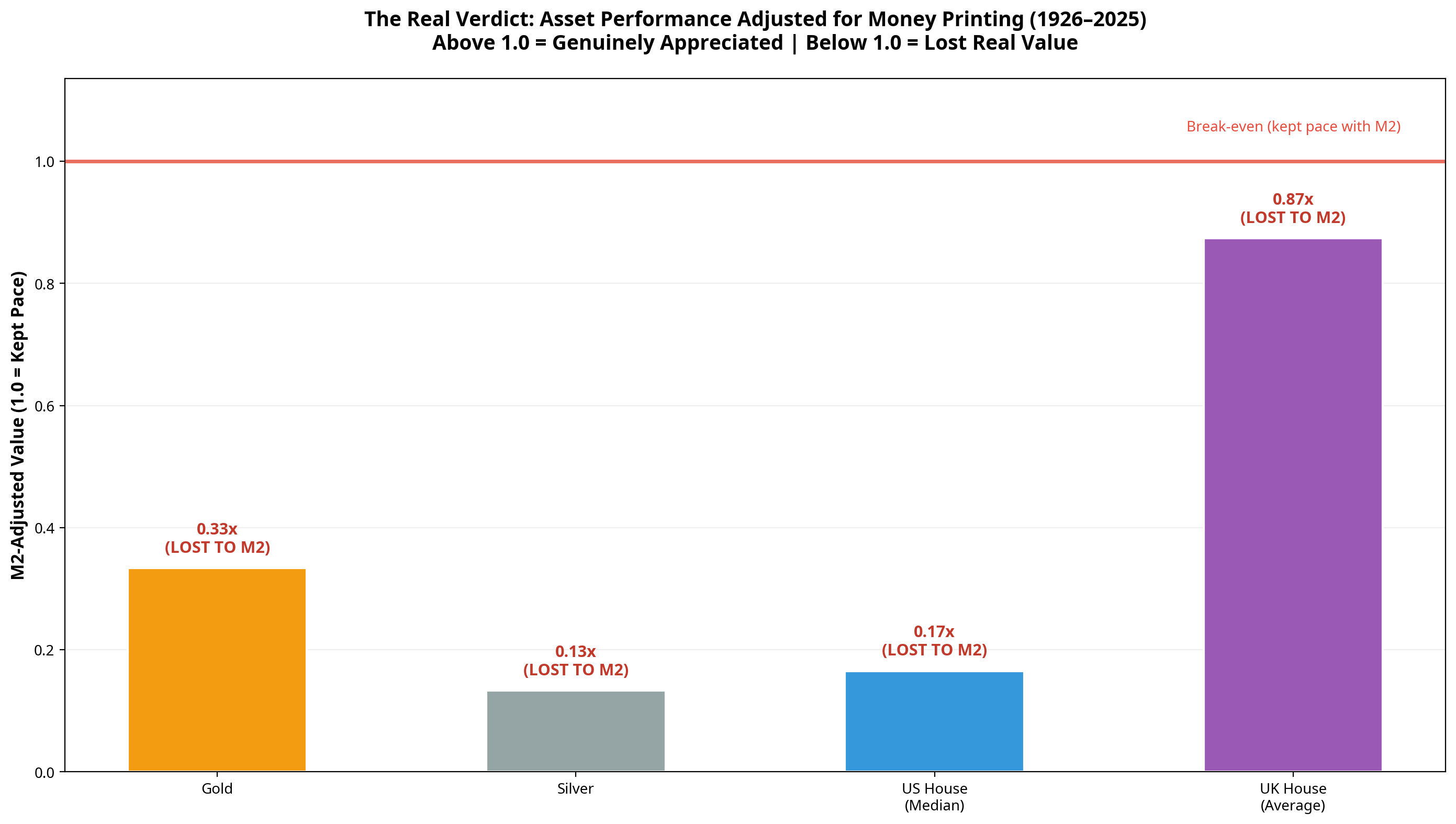
- Adjusted for M2, gold kept about a third of its 1926 value (0.33) and the median US house about a sixth (0.17).
- Priced in gold rather than dollars, the median US house fell from roughly 241 ounces in 1926 to about 120 ounces today.
- All of these assets still did far better than cash, which absorbed the full 99.8% dilution.
Did gold or real estate actually beat inflation over the last 100 years? That is the question for Part I of The Illusion of Wealth, where we compare gold, silver, US housing and UK housing from 1926 to 2026. Rather than adjusting for CPI, we measured each one against the growth of the US M2 money supply, because we wanted to see which of the traditional safe havens kept its value once the dilution of the dollar itself is taken into account.
Executive Summary
Most long-term performance figures quote either the nominal price rise or a rise adjusted for the Consumer Price Index (CPI), and neither tells us whether an asset has really held its value, because both leave out how much new money was being created at the same time. So we measured each asset against the expansion of the money supply itself, which we think is a more fundamental test.
Over the past 100 years the US M2 money supply has expanded by an extraordinary 503x, which has massively diluted what each dollar can buy [1]. We wanted to know whether the traditional “safe haven” assets (gold, silver, and real estate in both the US and UK) had genuinely gone up in value, or whether their rising prices mostly reflected a devalued currency.
What we found is that none of these major asset classes have genuinely appreciated when measured against monetary expansion. They have all seen massive nominal price increases, but once we set those against the rate of money printing over the last century, every single one of them had actually lost value.
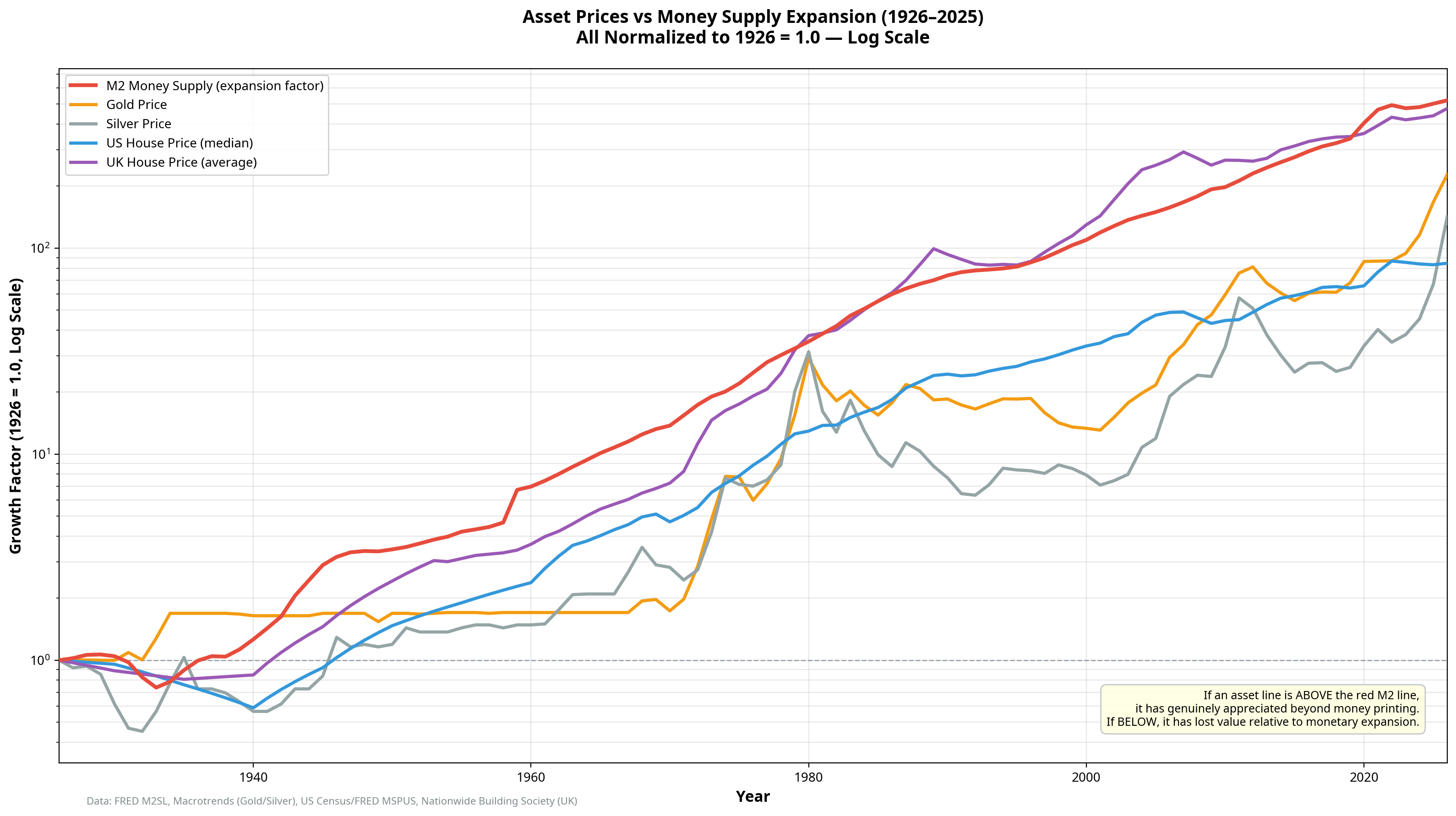
1. The Great Dilution: The Collapse of the Dollar
We started with the currency, since any asset price we looked at afterwards was going to be quoted in it.
Between 1926 and 2026 the US M2 money supply grew from approximately $43.7 billion to nearly $22 trillion [1] [2], which works out at a growth factor of 503x. Put the other way round, a single dollar from 1926 now represents less than one-fifth of a cent ($0.0019) of the total monetary pool, which is the baseline every price that follows has to be measured against.
The chart below shows the value of $1 falling purely because of monetary expansion, with the nominal price of the median US house overlaid.
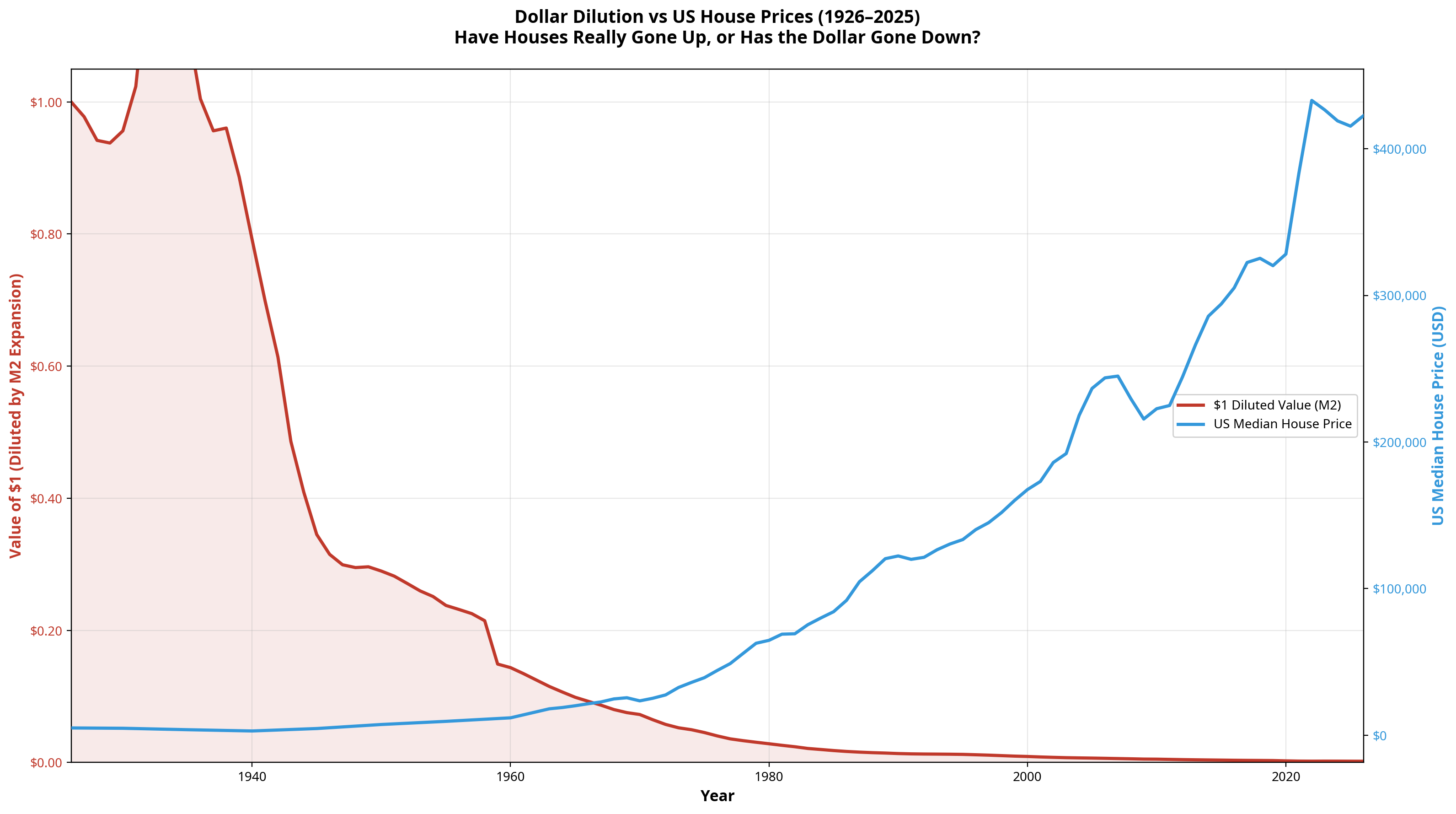
As the red area (the value of $1) collapses toward zero, the blue line (US house prices) inevitably rises to compensate for the currency’s lost purchasing power.
2. Nominal Growth vs. Real Growth
On the raw numbers the gains look extraordinary. A house in the UK that cost £619 in 1926 averaged over £271,000 in the data we used for this article [3], and gold, which was fixed at $20.67 an ounce, traded near $3,500 in the same dataset [4].
Once we placed those gains next to the expansion of the money supply, though, they stopped looking like gains at all.
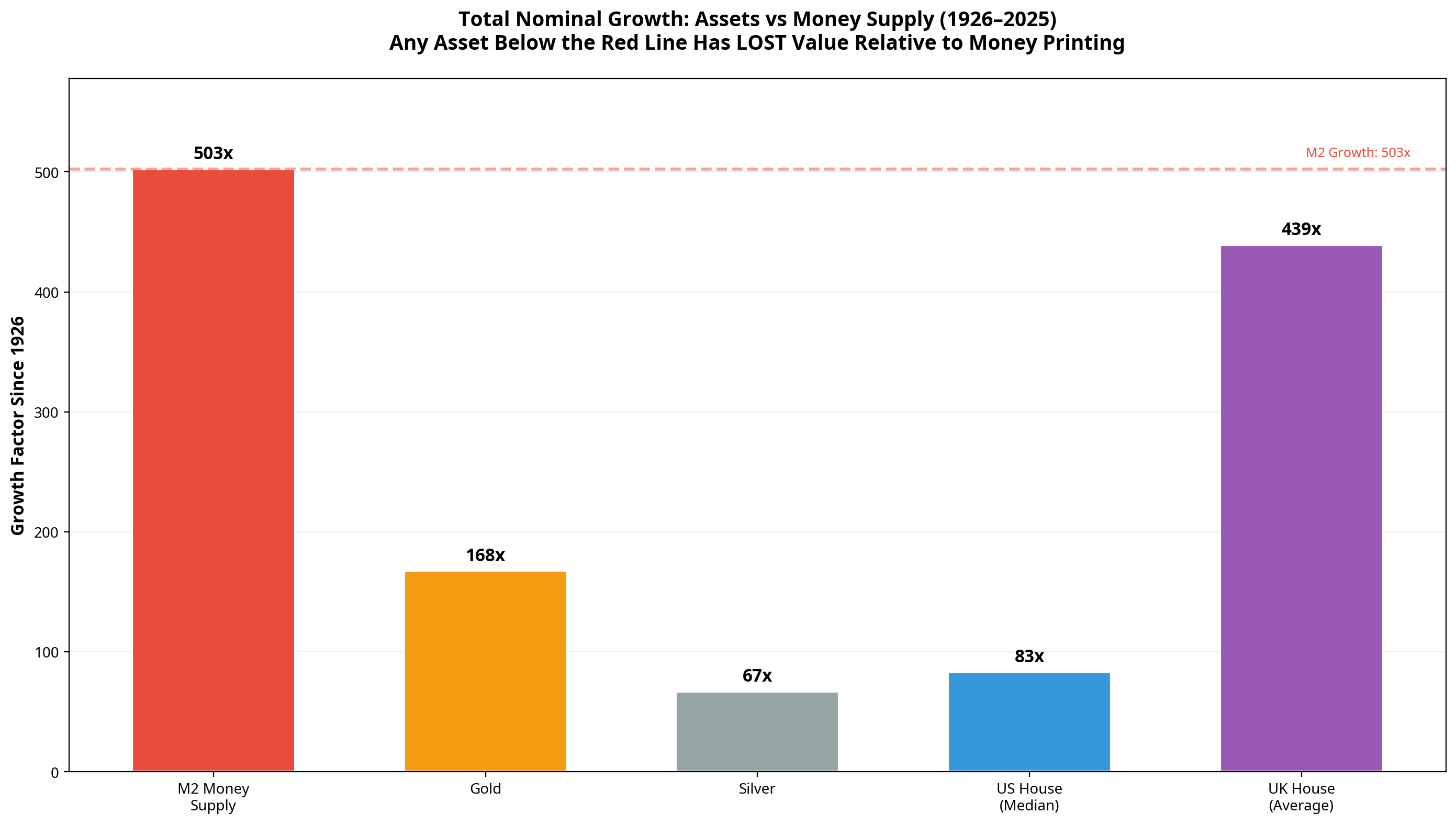
Because M2 grew by 503x, an asset’s price would have needed to rise 503x since 1926 just to have broken even with money printing.
Only UK Real Estate came close, growing by 439x, and we put that down largely to the severe constraints on housing supply in the United Kingdom compared with the United States. Gold grew by 168x, US real estate by 83x and silver by just 67x [4] [5], some of them falling a very long way short.
| Asset Class | 1926 Price | 2026 Price | Nominal Gain | M2-Adjusted Value | Verdict |
|---|---|---|---|---|---|
| M2 Money Supply | $43.7 Billion | $21,963 Billion | 503x | 1.00 | Baseline |
| UK House (Avg) | £619 | £271,809 | 439x | 0.87 | LOST |
| Gold | $20.72 / oz | $3,473 / oz | 168x | 0.33 | LOST |
| US House (Median) | $5,000 | $415,400 | 83x | 0.17 | LOST |
| Silver | $0.62 / oz | $41.50 / oz | 67x | 0.13 | LOST |
3. The Real Verdict: M2-Adjusted Performance
What we did next was put every asset on the same footing by setting it to 1.0 in 1926 and then dividing its performance by the growth in M2, so that the money printing is taken out and whatever is left is the asset’s own performance.
The way to read the chart is that anything above 1.0 has genuinely gone up in value and created real wealth beyond the rate of money printing, and anything below 1.0 has lost purchasing power against the total monetary pool, even if its price was hitting new highs at the time.
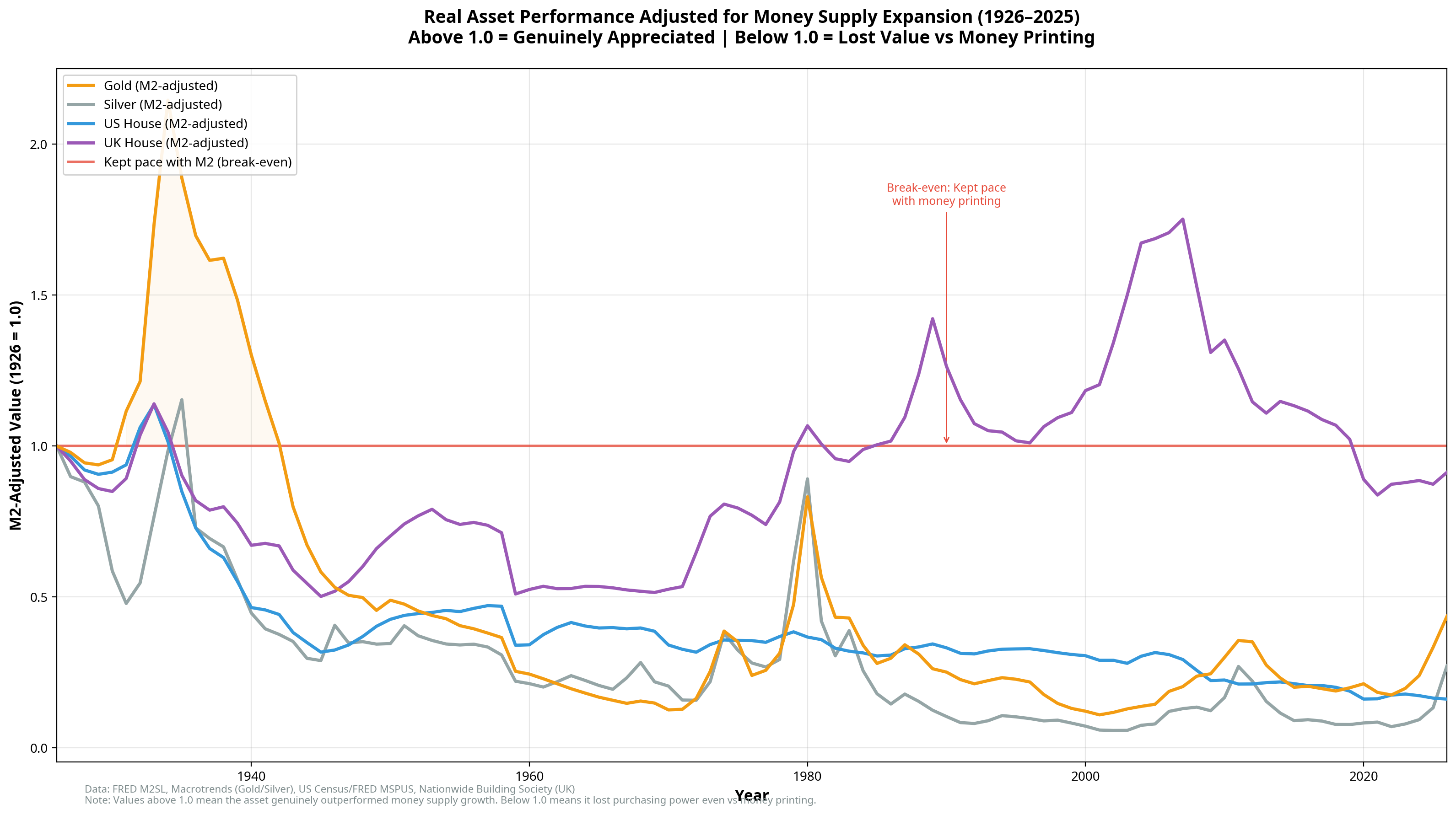
Key Observations from the M2-Adjusted Data:
- The 1970s Gold Shock: There was really only one period where gold actually beat monetary expansion, the inflation shocks of the late 1970s and early 1980s, with the peak in 1980 when for a short while it had doubled its relative purchasing power [4].
- The UK Housing Anomaly: UK property came out best of the group, and during the housing bubbles of the late 1980s and the mid-2000s UK houses did get ahead of money printing for a time [3]. That lead did not last, though, and since the 2008 financial crisis and the years of Quantitative Easing that came after it even UK real estate has been back under the break-even line.
- The US Housing Reality: American property gets talked about so much as a wealth-generating engine that the US figures are worth reading carefully. In our data the median US home has consistently lost value relative to monetary expansion since the 1930s, which means the big nominal price rises that homeowners have had are entirely an illusion created by the dollar being devalued [2].
4. The Ultimate Test: Pricing Houses in Gold
If the dollar is a broken measuring stick, it made sense to us to try pricing a house in another hard asset and see whether the picture changed.
So we priced the median US house in ounces of gold, and what came back was that the “price” of a house has remained remarkably stable over the last century.
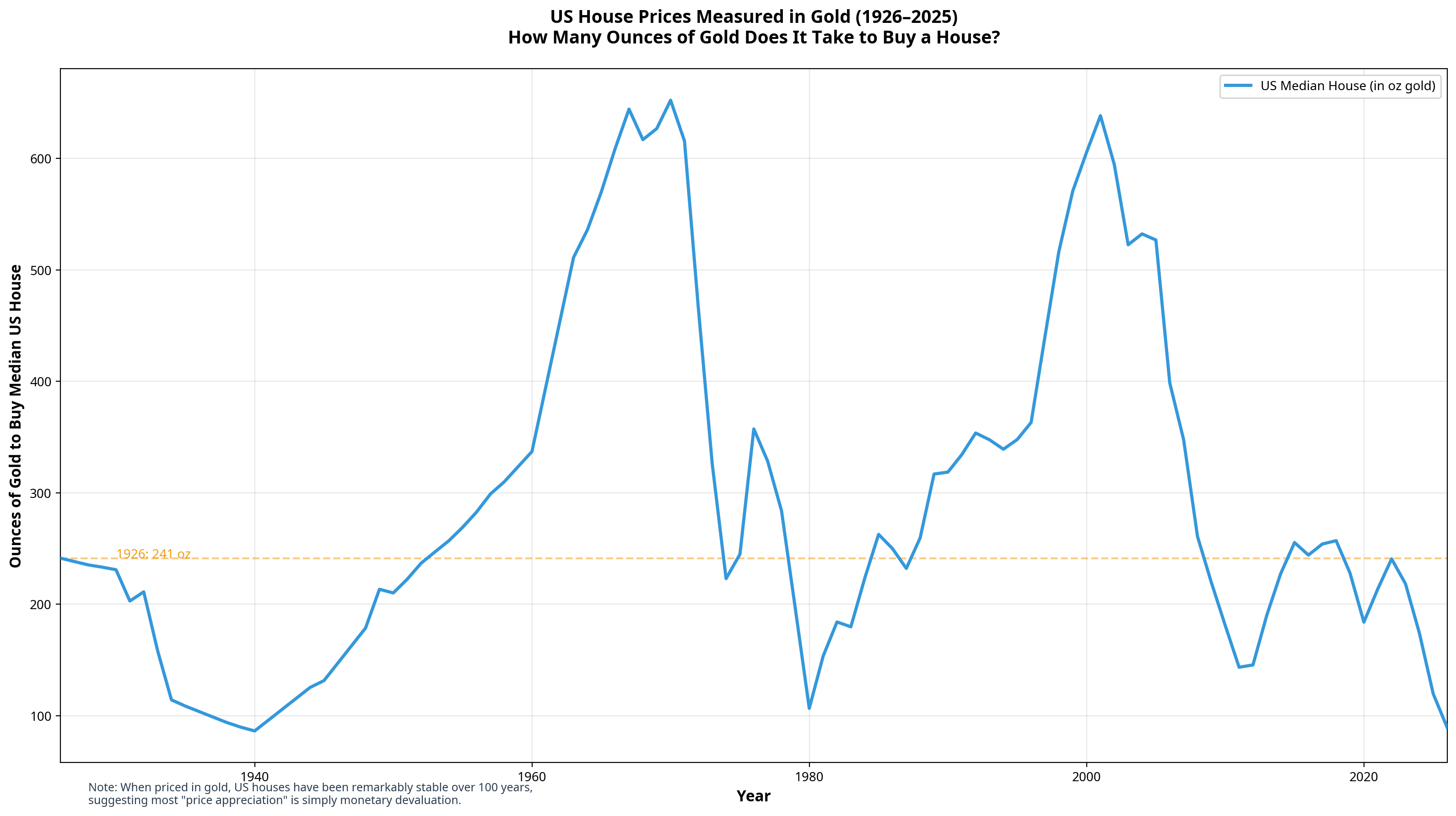
In 1926 you needed approximately 241 ounces of gold to buy the median US house, and today it is roughly 120 ounces, which means that in gold terms houses are actually cheaper now than they were a hundred years ago, even though the dollar price went from $5,000 to over $415,000.
We think that is about as clear a demonstration as you can get that the “appreciation” of real estate is almost entirely a function of the denominator (the fiat currency) collapsing, rather than the numerator (the house) becoming inherently more valuable.
Conclusion
Taken together, the data points to something uncomfortable about modern finance: most of what feels like getting richer is really our money getting weaker.
When investors celebrate their home doubling in value over 15 years, or gold hitting new all-time highs, a large part of what they are seeing is the destruction of their currency’s purchasing power. Holding these assets has still been vastly better than holding cash, which absorbed the full 99.8% dilution, but in our figures none of them kept pace with the sheer volume of new money central banks created over the last century.
To genuinely build wealth in an era of fiat currency, an asset has to do more than rise in nominal terms, because it needs to appreciate faster than new money is printed, and over the 100 years we tested the traditional safe havens did not manage that.
References
- [1] Federal Reserve Economic Data (FRED). “M2 Money Supply (M2SL).” Federal Reserve Bank of St. Louis.
- [2] Federal Reserve Economic Data (FRED). “Median Sales Price of Houses Sold for the United States (MSPUS).” Federal Reserve Bank of St. Louis.
- [3] Nationwide Building Society. “UK House Price Index - Historical Data.”
- [4] Macrotrends. “Gold Prices - 100 Year Historical Chart.”
- [5] Macrotrends. “Silver Prices - 100 Year Historical Chart.”


