


Over the past five sections, we established a mathematical reality: to preserve purchasing power, an asset’s compound annual growth rate (CAGR) must exceed the expansion rate of the M2 money supply. Historically, this required an absolute minimum yield of 6.56% annually.
For decades, the safest way to achieve this was to hold yield-bearing assets (like real estate or the S&P 500) and relentlessly reinvest the income. A more concentrated, higher-upside approach was the Berkshire Hathaway model, owning a curated basket of cash-flowing businesses that retained and compounded every dollar of profit.
However, the digital revolution fundamentally altered this environment. Technology companies and digital assets achieved in 15 to 30 years what took traditional compounding models 60 years.
This brings us to the ultimate question for an investor today: Looking forward to 2030 and 2035, which assets offer the best probability of beating the printing press, and what are the true risks involved?
The Fundamental Asymmetry: Fixed Supply vs. Infinite Expansion
Before looking at the individual scenarios, we need to understand the core driver of asset prices over the next decade: the ongoing debasement of fiat currency.
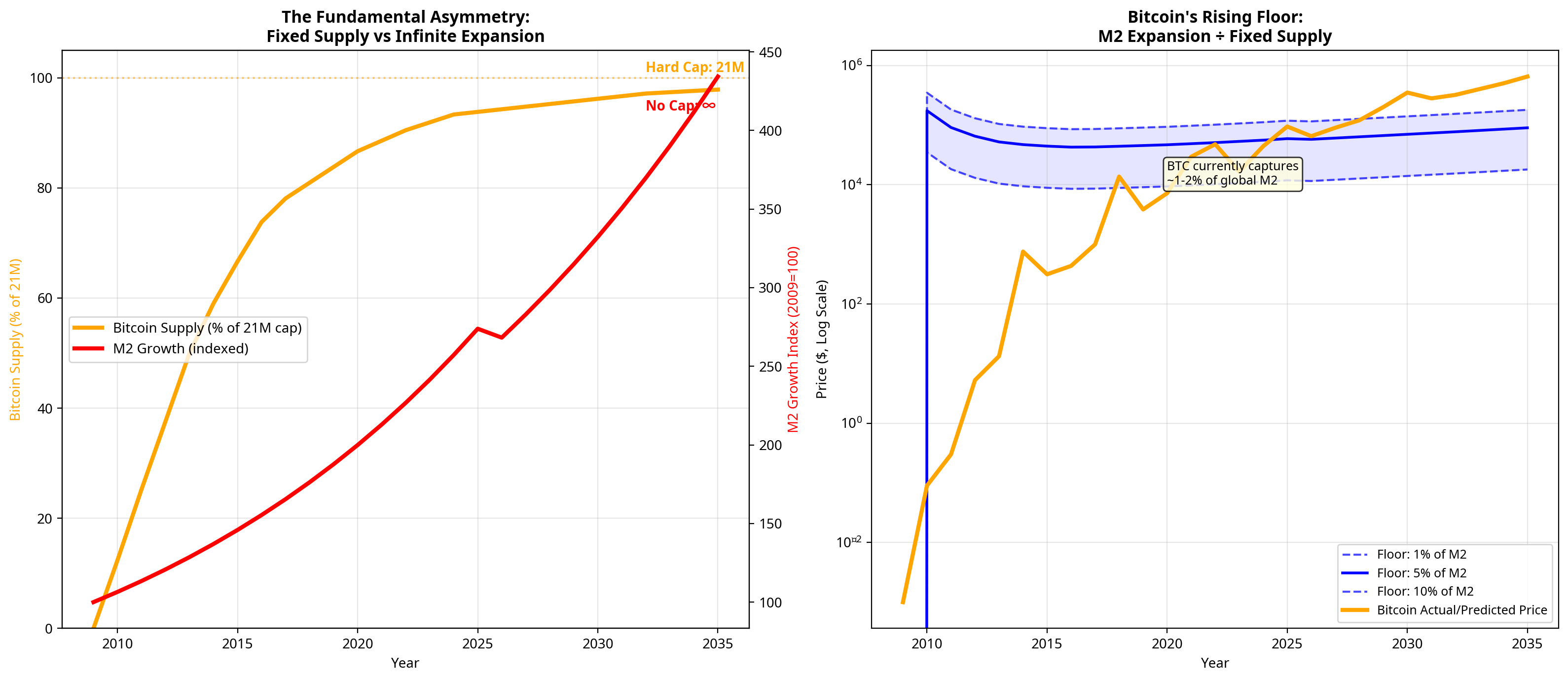
As shown in the chart above, at the time of writing in June 2026 the US M2 money supply sat at a record $22.8 trillion [1]. Assuming a conservative base-case growth rate of 5.5% annually, M2 would reach approximately $28.2 trillion by 2030 and nearly $37.0 trillion by 2035.
Bitcoin represents the mathematical opposite of this dynamic. With a hard cap of 21 million coins and an issuance rate that halves every four years, its supply schedule is entirely inelastic. At the time of writing, Bitcoin captured roughly 1% to 2% of global M2. If it merely maintains this percentage share as the fiat denominator expands, its price floor rises structurally every year.
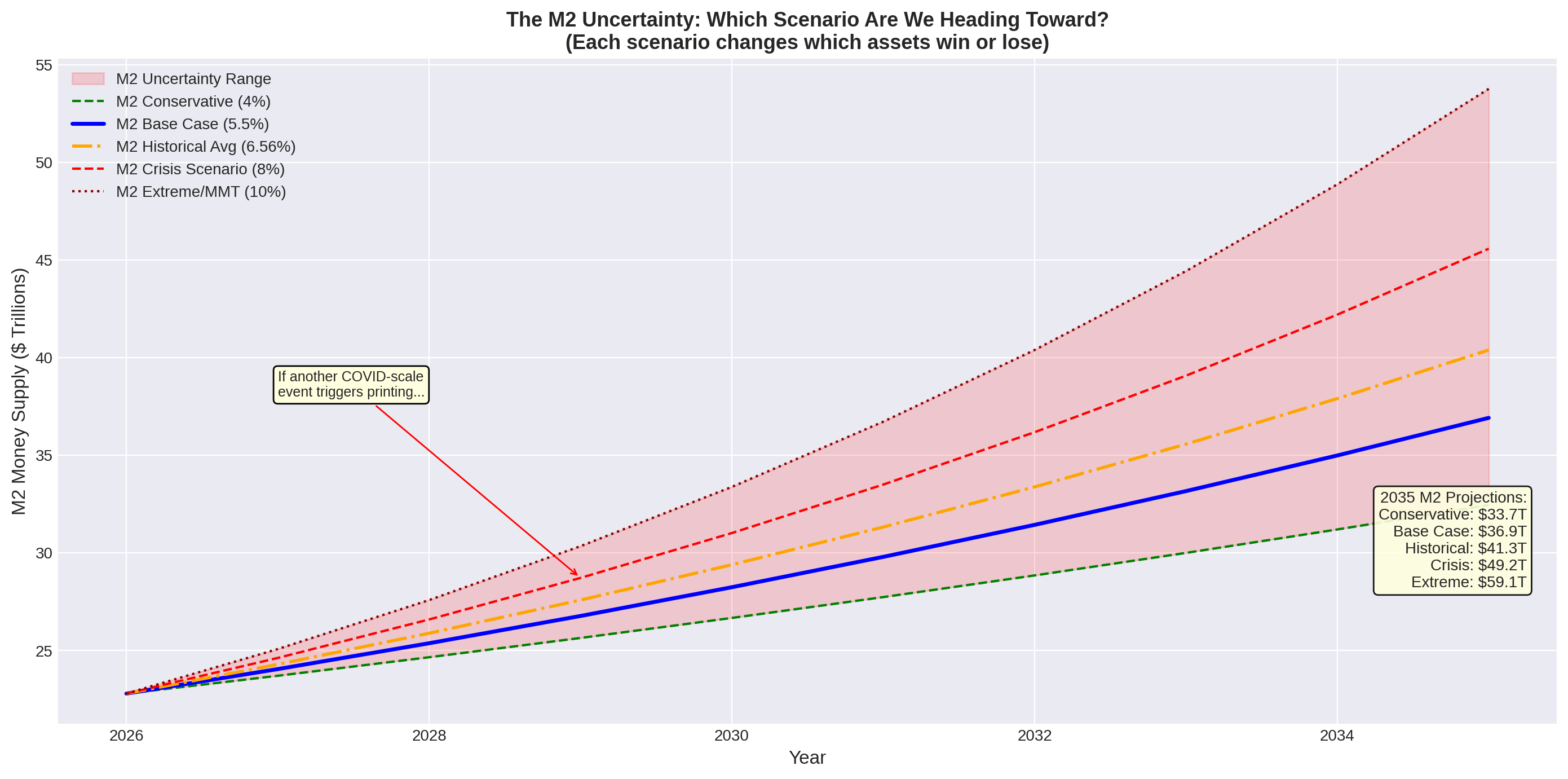
The range of outcomes depends heavily on the pace of monetary expansion. Under a bear case (4% annual M2 growth), the denominator still expands meaningfully. Under a bull case (7%+ growth, driven by recession-era stimulus), the purchasing power of every dollar erodes even faster, making scarce assets proportionally more valuable in nominal terms.
The Bubble Question: Is the AI Boom a Dot-Com Repeat?
When evaluating technology stocks like Nvidia or the broader Nasdaq, the most common objection is that we are experiencing a repeat of the 2000 dot-com bubble.
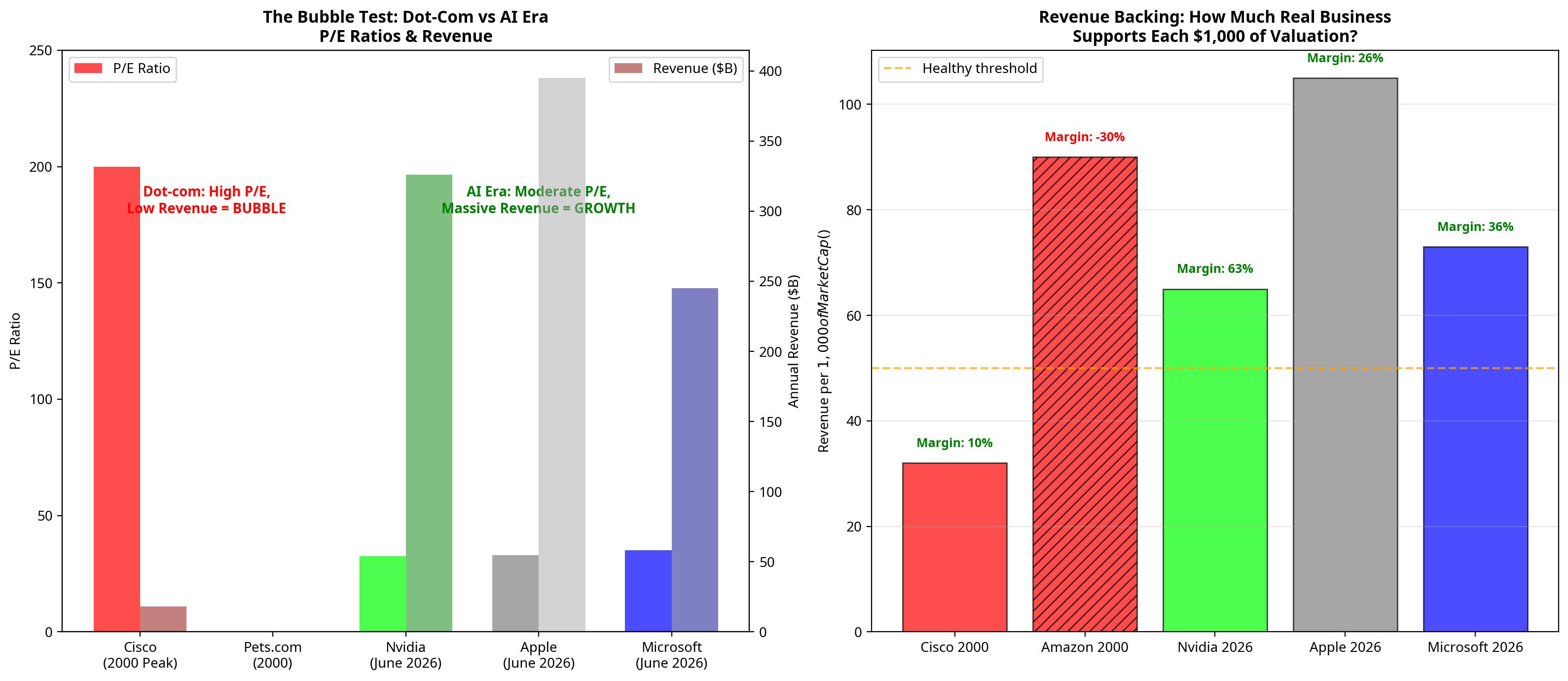
The data strongly refutes this comparison. In 2000, Cisco reached a peak market capitalisation of over $500 billion while generating roughly $18 billion in annual revenue, trading at a price-to-earnings (P/E) ratio near 200. Many dot-com darlings, such as Pets.com, had zero earnings and minimal revenue.
By direct comparison, Nvidia in mid-2026 generates massive, tangible cash flows. With projected FY2027 revenues of approximately $367 billion [2] and net profit margins exceeding 60% [3], Nvidia is trading at a forward P/E in the mid-20s. Its growth rate will inevitably decelerate (a mathematical certainty when dealing with hundreds of billions in revenue), but a slowing growth rate is not the same as a bubble bursting.
Diminishing Returns: The Maths of Large Numbers
A critical concept for both Nvidia and Bitcoin is the law of diminishing percentage returns.
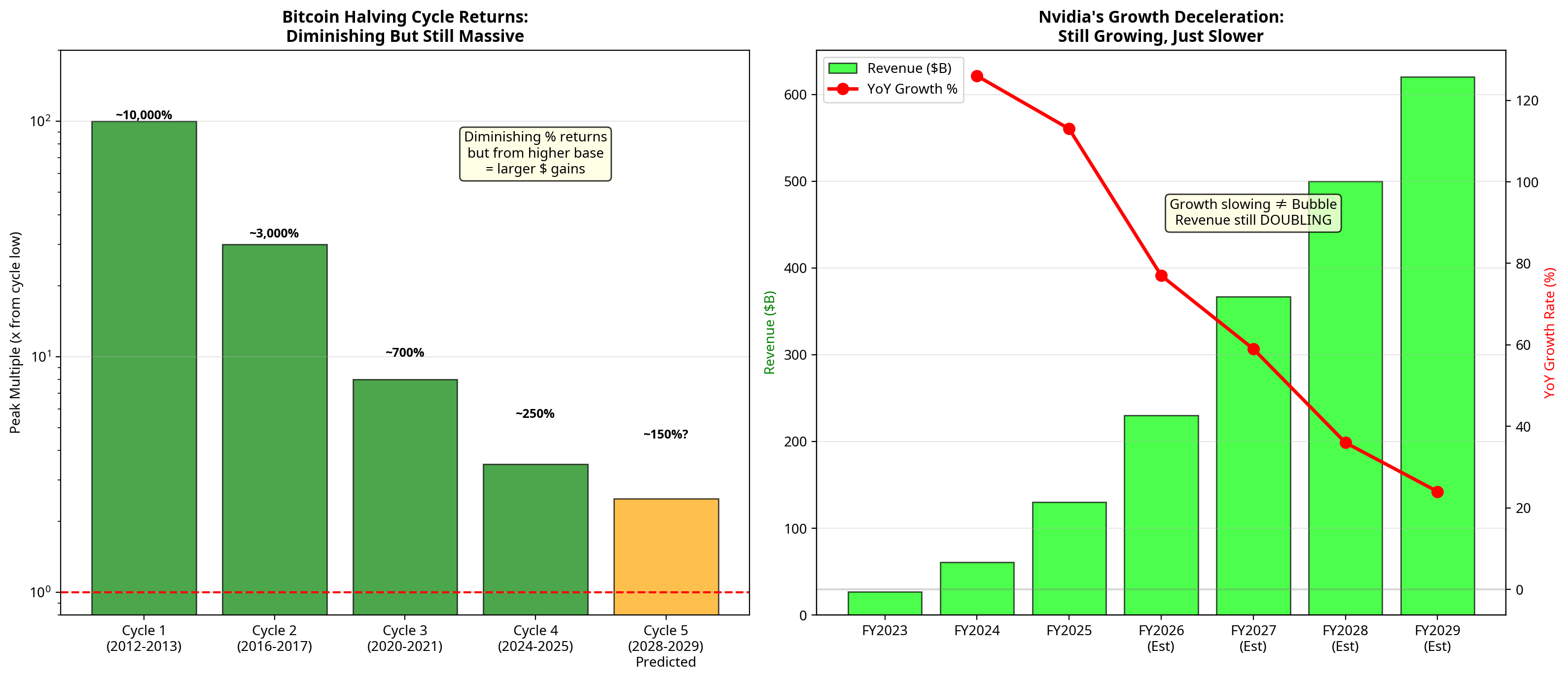
If you examine Bitcoin’s rolling CAGR, it trends diagonally downward over time. This does not mean Bitcoin is failing; it means it is maturing. A jump from $100 to $10,000 is a 10,000% return. A jump from $65,000 to $350,000 is “only” a 438% return, yet it represents a vastly larger absolute dollar gain.
The same applies to Nvidia. Doubling revenue from $30 billion to $60 billion is impressive, but growing from $230 billion to $367 billion requires an unprecedented scale of capital expenditure from hyperscalers. In our model, the era of 100x returns in these mega-cap assets looks to be behind them. Whether they keep beating a 5.5% M2 hurdle depends on the assumptions above, and they may not.
Price Predictions: 2030 and 2035 Scenarios
Based on current fundamentals, M2 projections, and historical growth decay models, we have mapped base-case scenarios for the next decade.
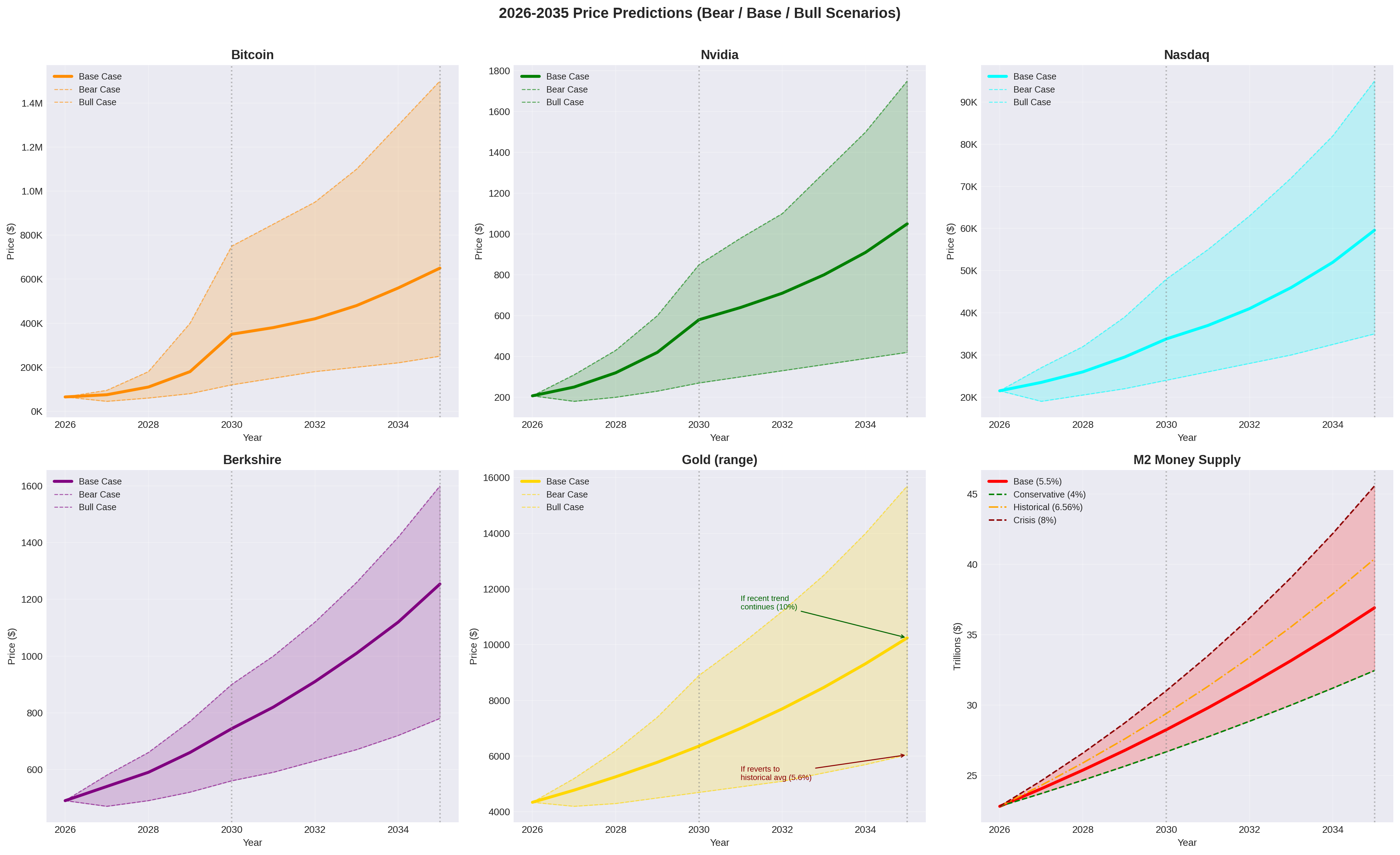
Base-case scenarios, 2026 to 2035 (illustrative, not guaranteed):
| Asset | June 2026 | 2030 Base Case | 2035 Base Case | Nominal Multiple |
|---|---|---|---|---|
| Bitcoin | $65,000 | $350,000 | $650,000 | 10.0x |
| Nvidia | $207 | $580 | $1,050 | 5.1x |
| Nasdaq | 21,500 | 33,800 | 59,600 | 2.8x |
| Berkshire | $490 | $744 | $1,254 | 2.6x |
| Gold | $4,345 | $6,362 | $10,246 | 2.4x |
| M2 Supply | $22.8T | $28.2T | $36.9T | 1.6x |
Note: These are modelled scenarios for illustration, not guarantees or recommendations. They assume a 5.5% annual M2 expansion and a normalisation of tech P/E multiples, and the outcomes change if either assumption proves wrong.
Important information
Capital at risk. The value of investments can fall as well as rise and you may get back less than you invest. Past performance is not a reliable indicator of future results. Educational information only, not financial advice. Read our disclaimer.
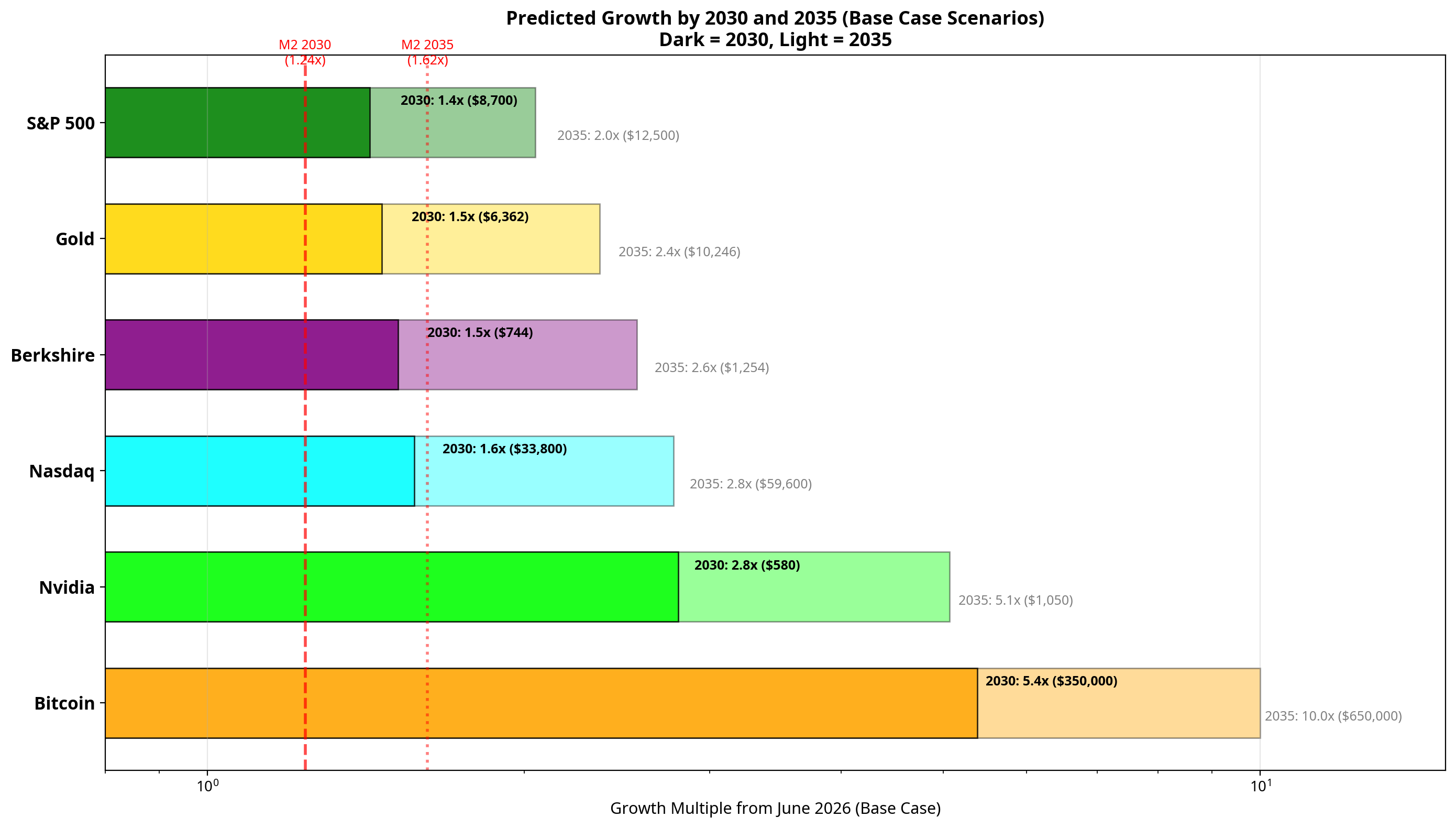
The summary chart above consolidates these projections across all scenarios. Even in the bear case, the model has Bitcoin and Nvidia outpacing money supply expansion, though the margin of safety narrows considerably.
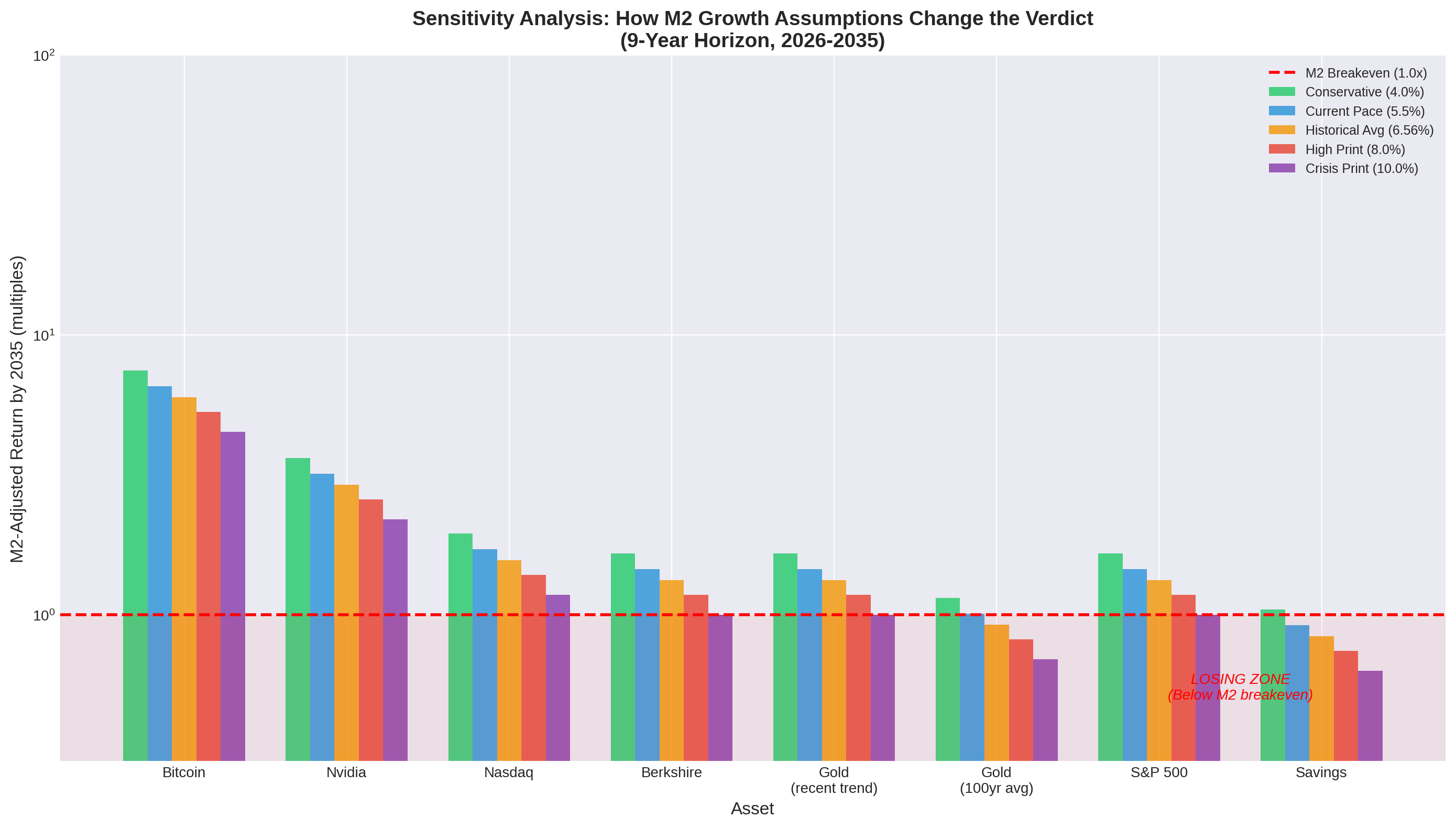
The sensitivity analysis reveals a telling insight: the faster the money supply expands, the higher the nominal price of every asset, but only those with genuine scarcity or structural earnings growth deliver real returns. Under aggressive monetary expansion (7%+ M2 growth), Bitcoin’s outperformance widens, whilst gold and Berkshire struggle to break even in real terms.
The Real Test: M2-Adjusted Returns
Nominal price targets are an illusion. The only metric that matters is whether an asset’s purchasing power expands faster than the money supply.
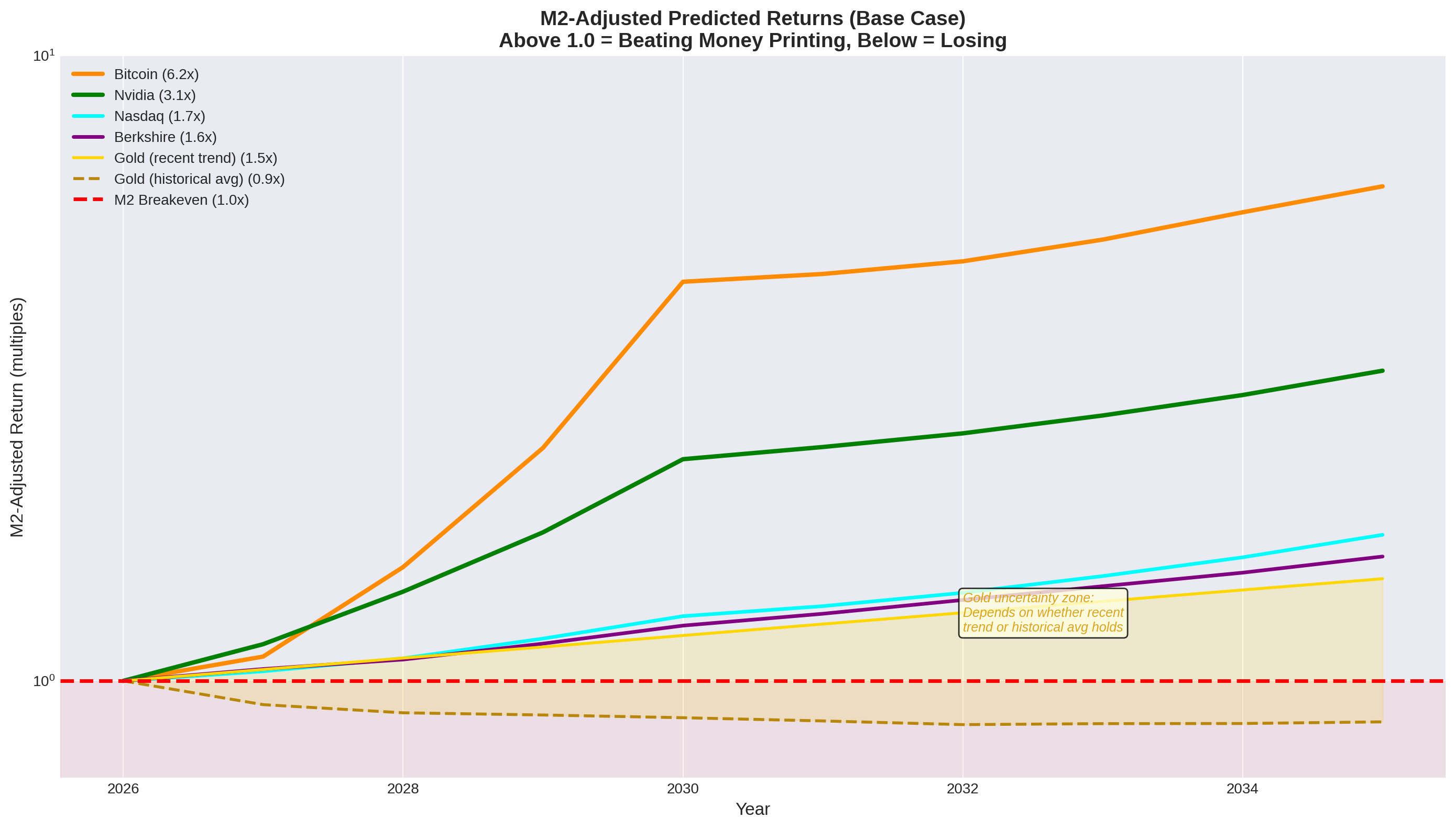
By 2035, M2 is projected to expand by roughly 1.6x. If an asset does not grow by at least 1.6x, the investor has lost real wealth.
In our base-case model:
- Bitcoin delivers a 6.2x real return (adjusted for M2).
- Nvidia delivers a 3.1x real return.
- Nasdaq delivers a 1.7x real return.
- Berkshire Hathaway and Gold barely clear the hurdle at 1.6x and 1.5x real returns, respectively.
Bitcoin vs. Gold: The Scarcity Paradox
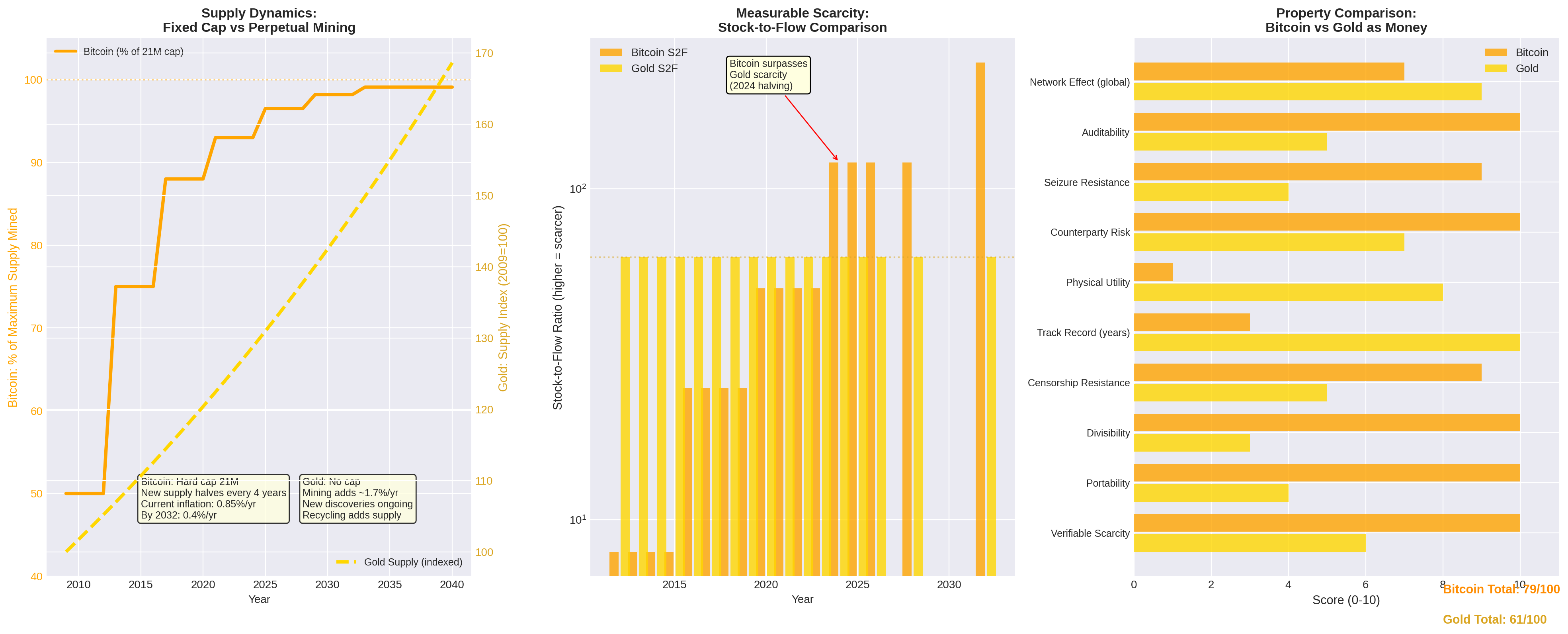
Gold has served as a store of value for millennia, but its supply is not truly fixed. Annual mining adds roughly 1.5% to the above-ground stock, and there is no theoretical cap. Bitcoin, by contrast, has a mathematically enforced ceiling of 21 million units. When both assets are priced against M2, Bitcoin’s scarcity premium becomes plainly visible.
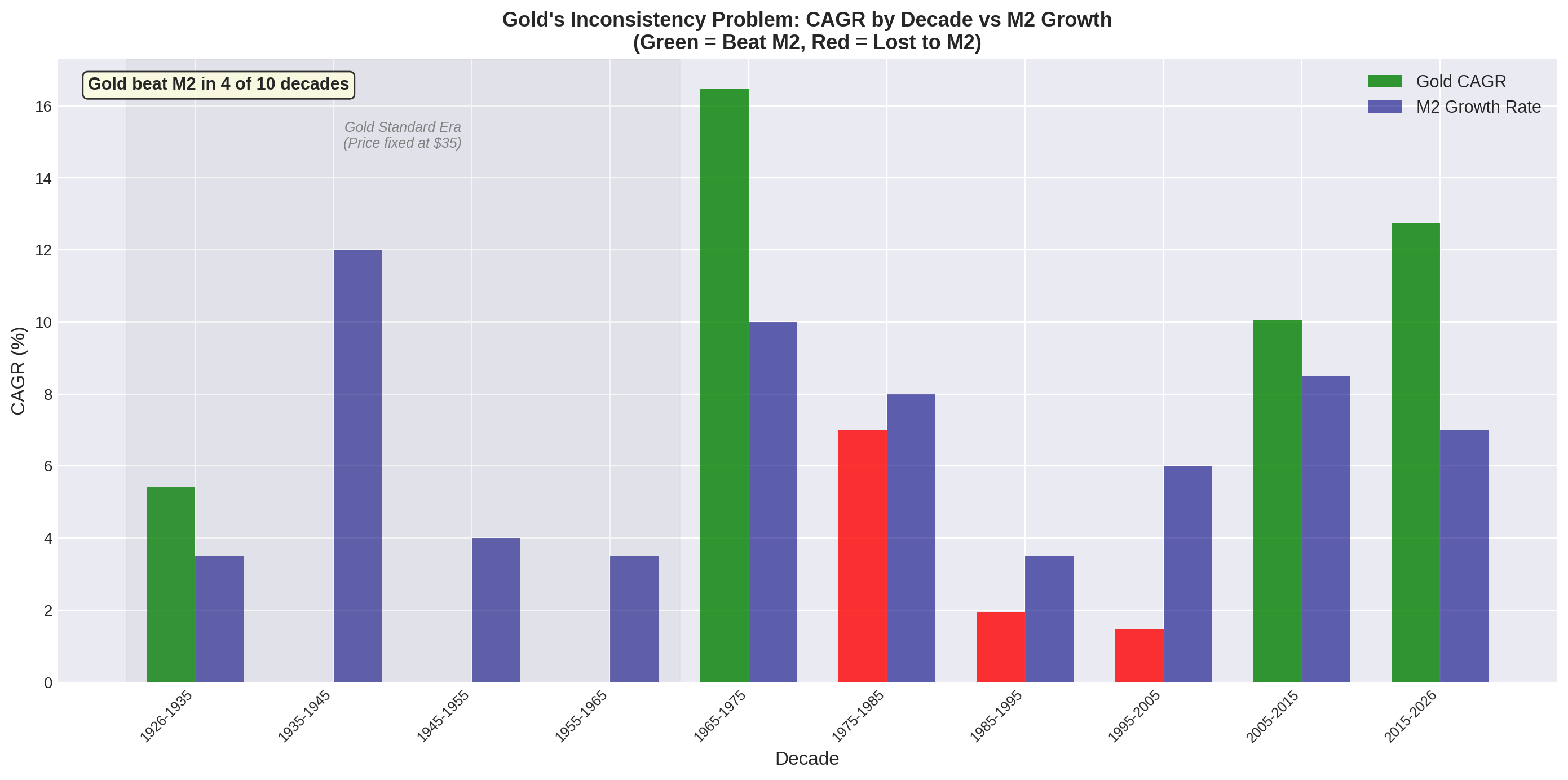
Gold’s track record as an inflation hedge is surprisingly inconsistent. Between 1980 and 2000, gold fell by over 60% in nominal terms whilst the money supply tripled. Its performance correlates more closely with sentiment and geopolitical anxiety than with monetary expansion. For investors looking for a hedge against currency debasement, Bitcoin’s fixed supply looks structurally stronger on paper, though with significantly higher volatility and the risk of large losses.
Important information
Don't invest unless you're prepared to lose all the money you invest. This is a high-risk investment and you should not expect to be protected if something goes wrong.
Cryptoassets are largely unregulated in the UK, so you are unlikely to have access to the Financial Ombudsman Service or the Financial Services Compensation Scheme if something goes wrong. Educational information only, not financial advice. Read our disclaimer.
The Modern Investor’s Decision Matrix
If Berkshire Hathaway was the definitive “safe” compounder of the 20th century, on our reading the Nasdaq Composite has taken its place in the 21st century.
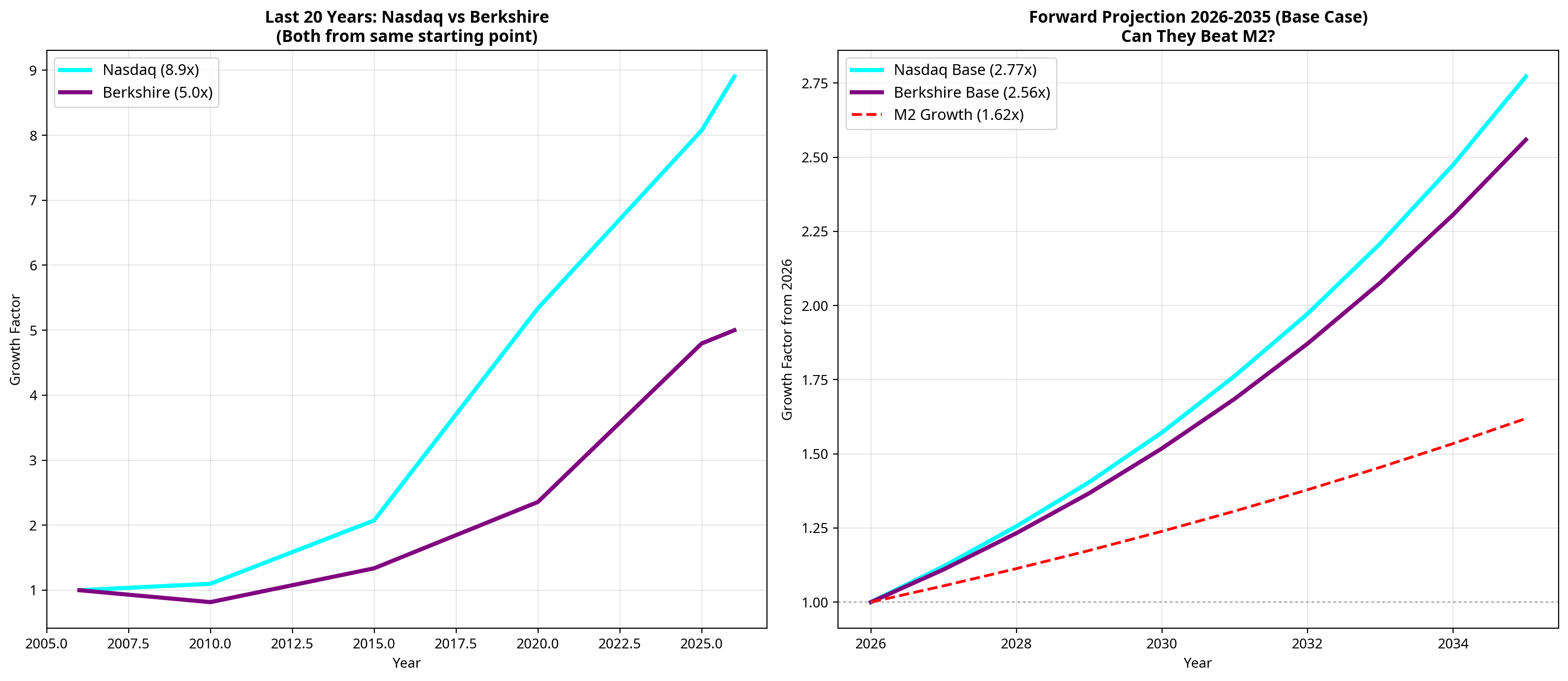
Whilst Berkshire requires faith in the capital allocation skills of a single management team (in a post-Buffett era), the Nasdaq provides automated, diversified exposure to the companies building the future of human infrastructure.
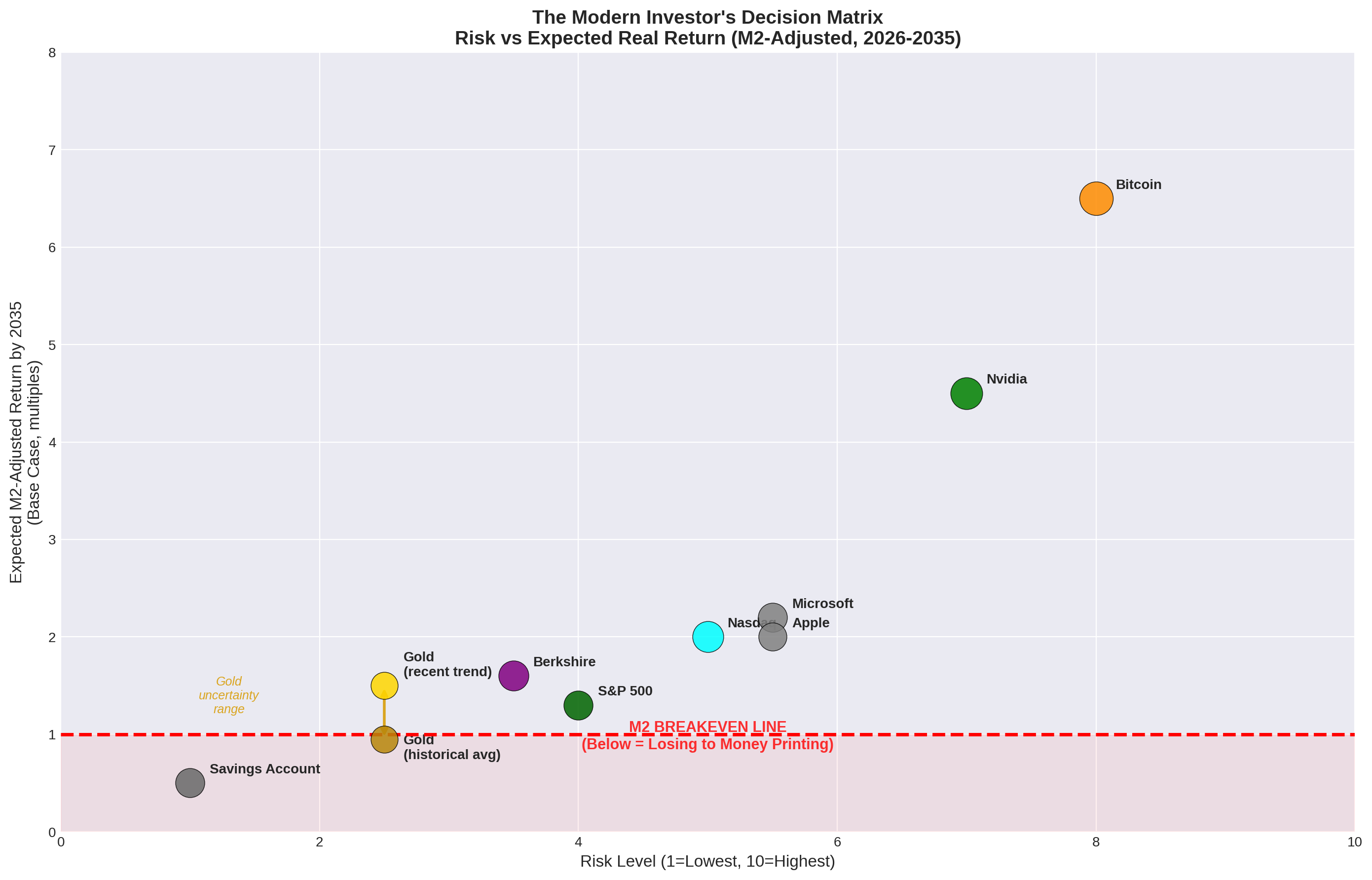
In our framework, the asset groups fall along this risk-reward spectrum (an illustration, not a suggested portfolio):
- The Baseline (Cash/Savings): On our model, likely to lose 3% to 5% of its purchasing power a year while money supply growth outpaces savings rates.
- The Preservers (Gold & Berkshire): In the base case they roughly keep pace with M2, with limited upside, and both can still fall in value.
- The Modern Compounder (Nasdaq): In our framework, a balance of diversification and tech-driven growth, with a base-case real return of 1.7x by 2035 that is a scenario rather than a guarantee for the next decade.
- The High-Conviction Bet (Nvidia/Mega-Cap Tech): Has produced the highest returns of the equities here, backed by large cash flows, but carries the inherent risk of single-company disruption or regulatory action.
- The Asymmetric Hedge (Bitcoin): Carries the highest volatility and the risk of losing most or all of the money invested, but its fixed supply makes it the strongest structural counterweight to fiat expansion in our data.
The Final Verdict: The 100-year history of the US dollar suggests that conservative investing has often been the riskiest path of all, because standing still meant falling behind. With the money supply expanding by trillions, in our base-case scenarios, scarce digital assets and AI infrastructure companies came out ahead of M2. Each of them can fall sharply, the scenarios may not happen, and nothing here is personal financial advice. Readers assessing the physical systems behind that thesis can explore GPU servers for AI and compute, including workstation, rack and frontier routes.
References
[1] Federal Reserve Economic Data (FRED). “M2 Money Supply (M2SL).” May 2026. [2] Simply Wall St. “NVIDIA (NasdaqGS:NVDA) Stock Forecast & Analyst Predictions.” June 2026. [3] Yahoo Finance. “NVIDIA Corporation (NVDA) Valuation Measures.” June 2026.


