


Key takeaways
- On price alone the S&P 500 rose 468x between 1926 and 2025 while M2 grew 503x, leaving it with an M2-adjusted value of 0.932, roughly 6.8% behind the money supply.
- The Dow Jones grew 292x over the same period and lost more than 40% of its value relative to M2.
- The 3-month Treasury bill, our proxy for safe savings, averaged 3.17% a year against average M2 growth of 6.66%, a gap of 3.48% every year for a century.
- A dollar saved in 1926 with all interest reinvested grew to $21.68, but it needed to reach $503 to keep its purchasing power, so in M2 terms it is now worth 4.3 cents.
- Measured against M2, the dot-com peak was the S&P 500 briefly catching up to the 1.0 break-even line before falling away again.
Does the stock market beat inflation once you measure it against money printing, and how badly does a savings account fall behind? In Part II of The Illusion of Wealth we test the S&P 500, the Dow Jones, the big market crashes and an ordinary savings account against the growth of the US M2 money supply from 1926 to 2025, to see whether shares and savings actually grew anyone’s wealth or mostly kept pace with a shrinking dollar.
Executive Summary
In Part I we found that the traditional safe-haven assets, gold, silver and real estate, had all failed to outpace the 503x expansion of the US M2 money supply over the last century, so the obvious next question was whether the stock market had done any better.
So this second part turns to the stock market, to the big historical crashes and to cash savings. We were testing three things at once: whether the stock market genuinely creates wealth, whether “bubbles” are isolated events or really symptoms of what money is doing, and whether the idea of “earning interest” in a savings account actually holds up once you do the arithmetic.
What we found was striking. Over 100 years even the mighty S&P 500 has not fully kept up with money printing, the big crashes line up closely with periods when monetary growth was tightening, and cash savings, which look as though they have grown when you only see the nominal balance, turned out to have lost almost all of their purchasing power.
Section A: Stock Indices vs Money Supply
The stock market is widely thought of as the ultimate wealth-generation engine, so we wanted to test that properly by comparing the nominal growth of the S&P 500 and the Dow Jones Industrial Average with the M2 money supply from 1926 to 2025 [1] [2] [3].
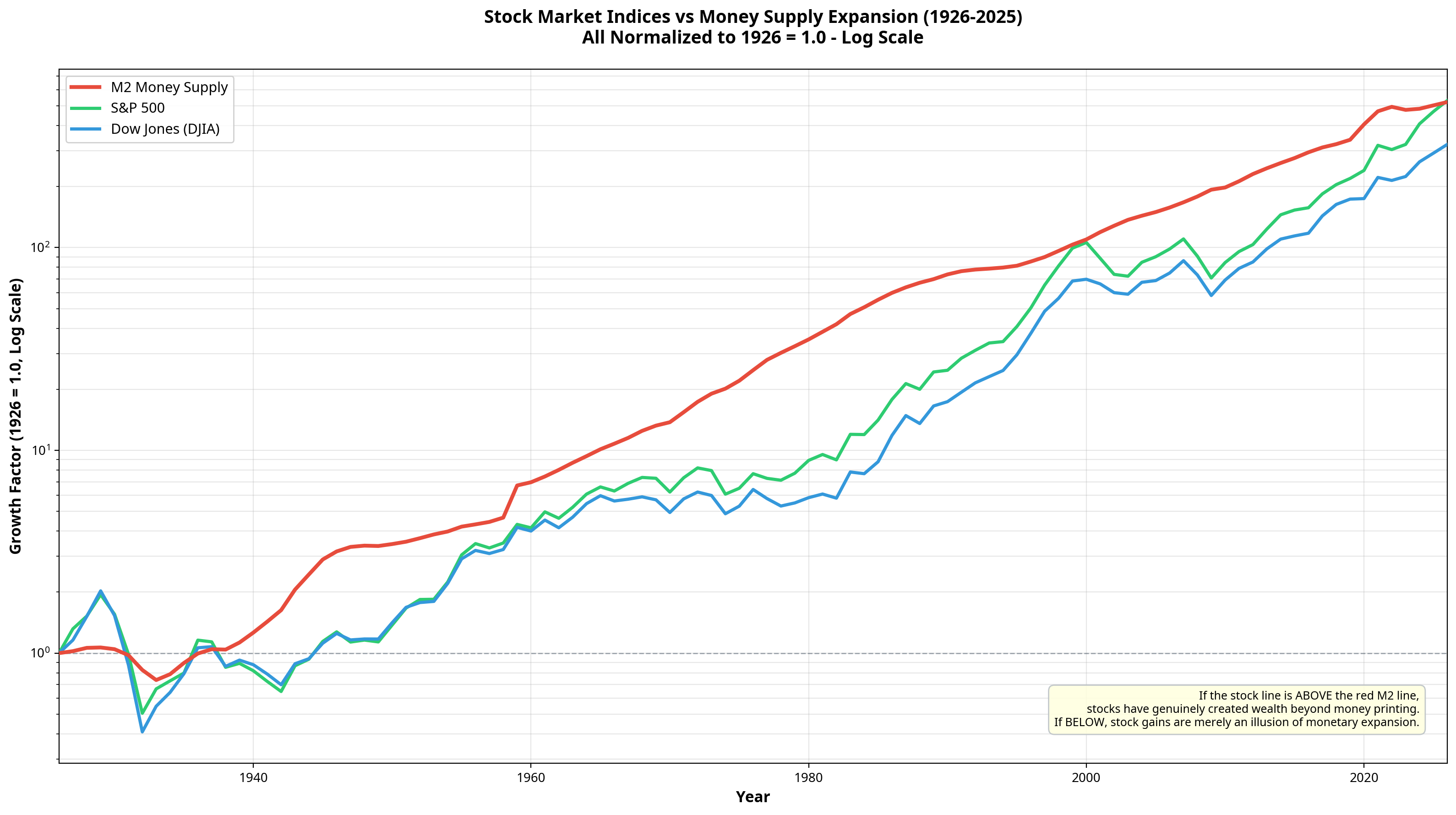
When viewed on a logarithmic scale, the correlation between stock prices and money supply expansion is unmistakable.
The Nominal Illusion
In nominal terms the stock market’s performance looks spectacular. The S&P 500 went from an annual average of 13.40 in 1926 to over 6,276 in 2025, a massive 468x nominal gain, and the Dow Jones grew by 292x over the same period.
Over exactly the same window, though, the M2 money supply expanded by 503x.
That changed the picture a lot once we adjusted the indices for it, because to genuinely create wealth beyond the rate at which the currency is being debased, an asset’s M2-adjusted value has to stay above 1.0, and as the next chart shows that is a much harder bar to clear.
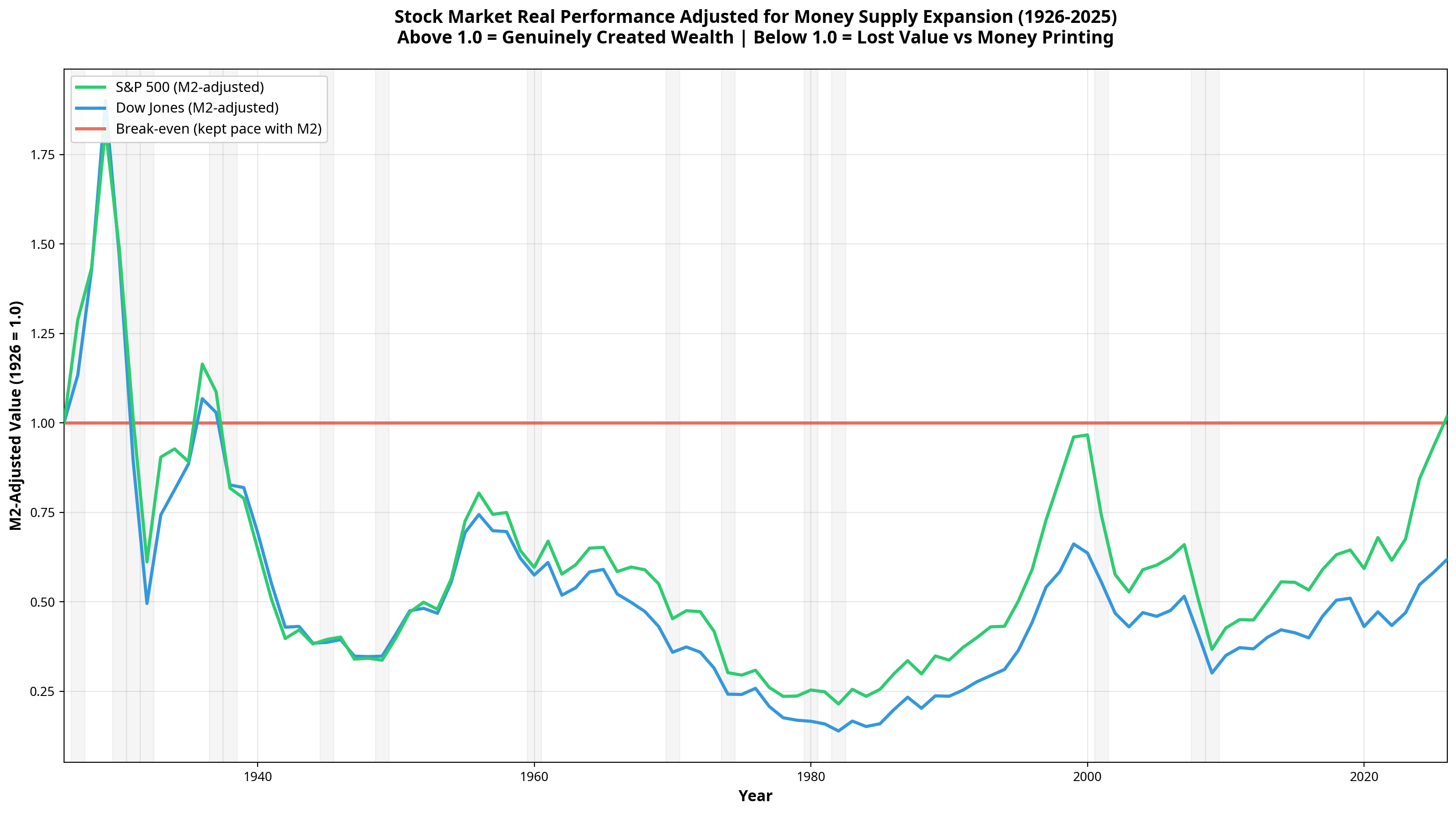
What the chart above shows is that neither the S&P 500 nor the Dow Jones has managed to stay above the 1.0 break-even line over the full century. The S&P 500 currently sits at an M2-adjusted value of 0.932, which means it has lost roughly 6.8% of its value relative to the total monetary pool, and the Dow Jones has done much worse than that, losing over 40% of its relative value.
We would still say stocks have preserved wealth far better than cash or precious metals did, but a large part of their legendary “growth” turned out, when we looked at it this way, to be the mirror image of a collapsing currency.
Section B: Bubbles, Crashes, and Money Printing
Market bubbles such as the Dot-com boom or the 2008 housing crisis tend to be described in the financial media as isolated events, driven by irrational exuberance or by one sector failing, but when we mapped them against the rate of money supply growth a different story started to come through.
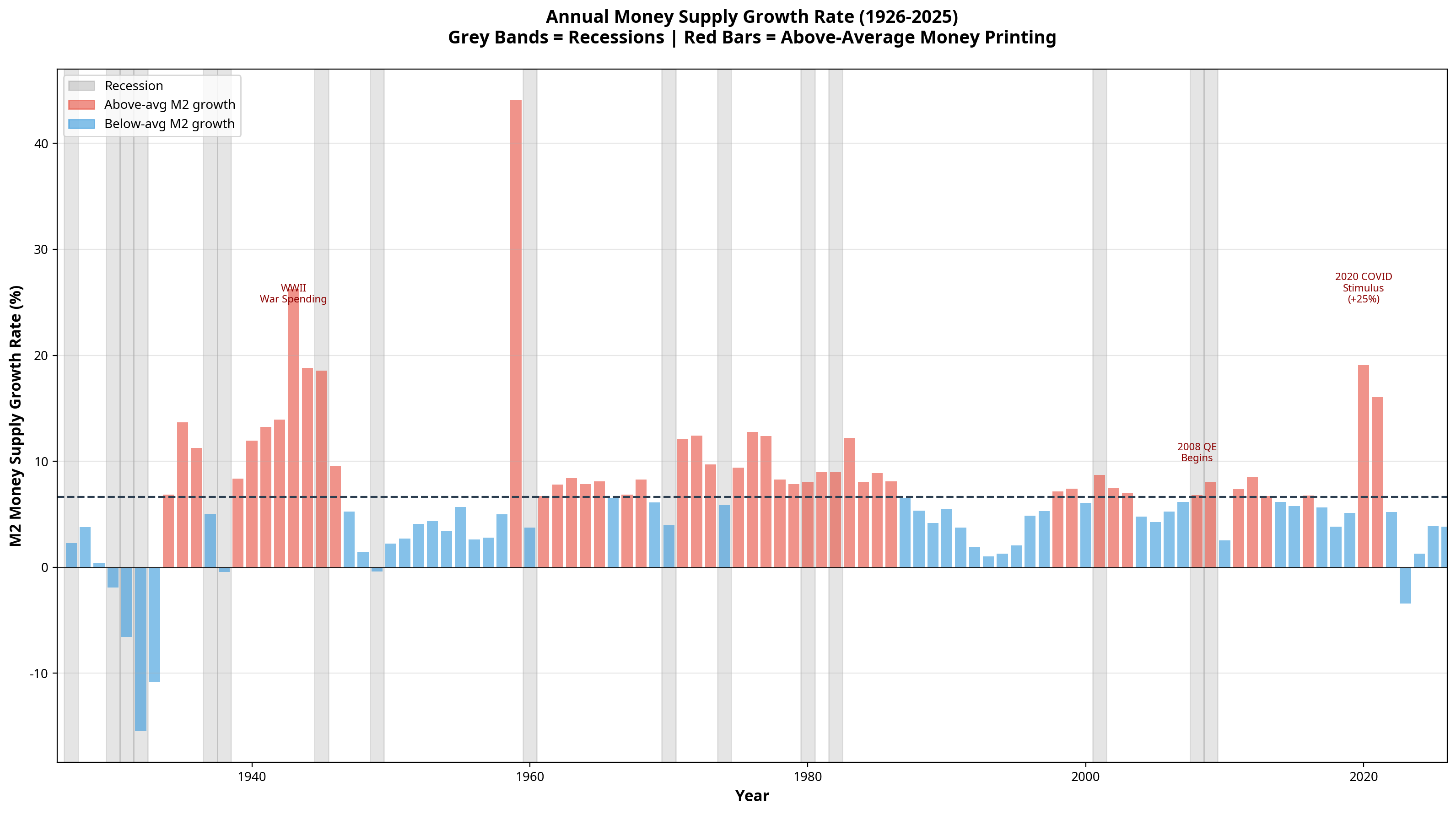
Over the long run M2 has grown by approximately 6.66% a year on average. What we saw in the data was that the major market crashes frequently came after periods when monetary expansion slowed down or dipped below that average, and that the major “recoveries” were almost entirely fuelled by aggressive new money printing, the clearest examples being the Quantitative Easing (QE) era after 2008 and the massive stimulus of 2020.
The Bubble Illusion
This is the pattern we have called the “Bubble Illusion.”
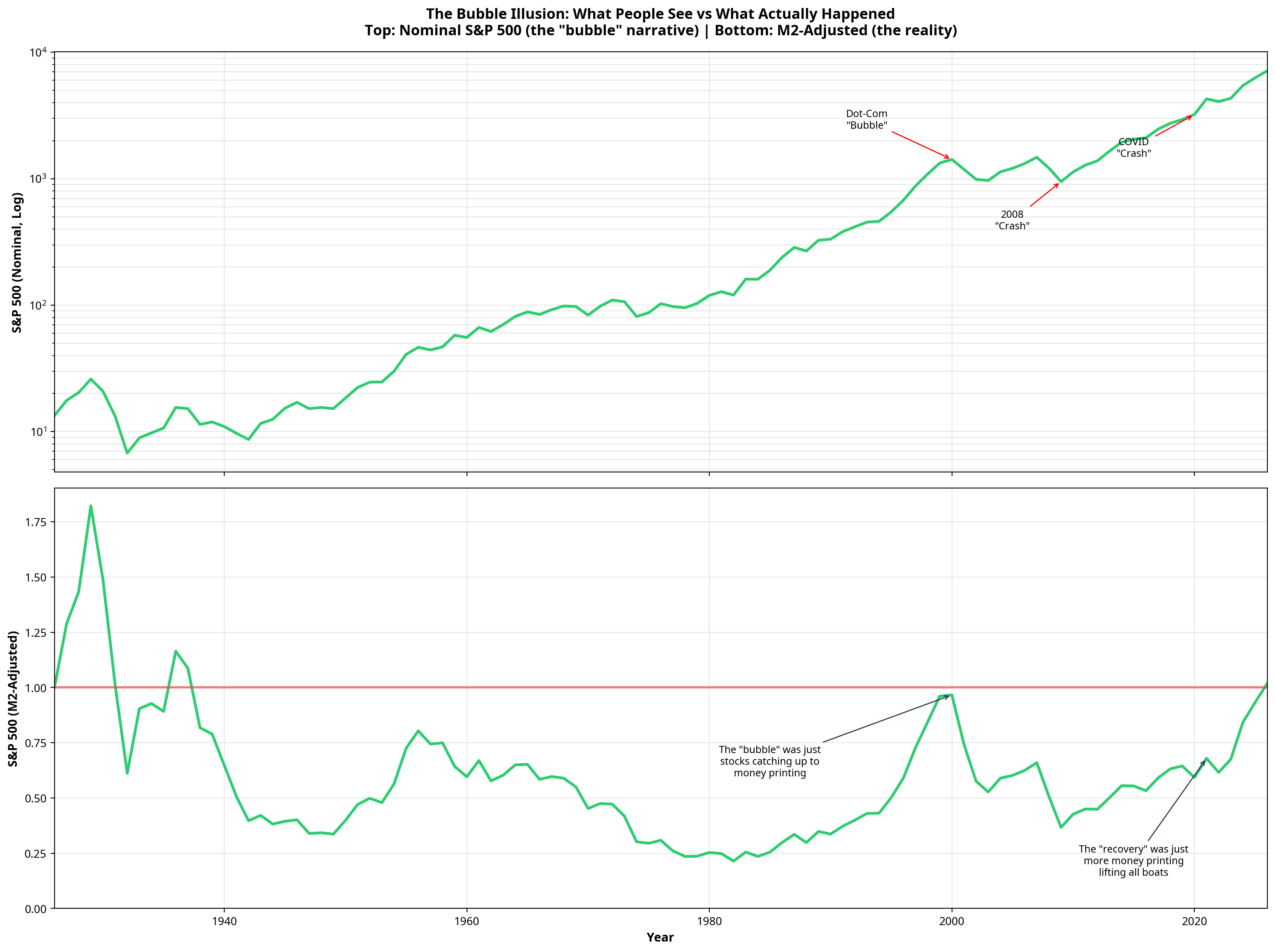
Take the Dot-com “bubble” of the late 1990s. In nominal terms (the top chart) it looks like an extreme deviation from the trend, but in M2-adjusted terms (the bottom chart) the late 1990s were simply the only time in recent history when the S&P 500 managed to briefly catch back up with the rate of money printing, touching the 1.0 break-even line before falling away again.
We read the post-2009 “longest bull run in history”, and the rapid recovery from the 2020 COVID crash, in much the same way. Neither looks to us like a sudden surge in corporate value, because both line up with the stock market re-pricing itself upwards to absorb the trillions of new dollars injected into the system, and so the “recovery” was really more money printing lifting all boats.
Section C: The Savings Account Trap
Perhaps the most widespread financial myth is that putting money in a savings account paying 4% or 5% means you are “earning money”, and that belief rests on the assumption that official CPI inflation (typically targeted at 2-4%) is the true measure of how fast the currency is being devalued.
Our hypothesis was that true inflation, measured by monetary expansion, is much higher than that, in which case traditional savings accounts would guarantee a loss of wealth, and the data bore that out entirely.
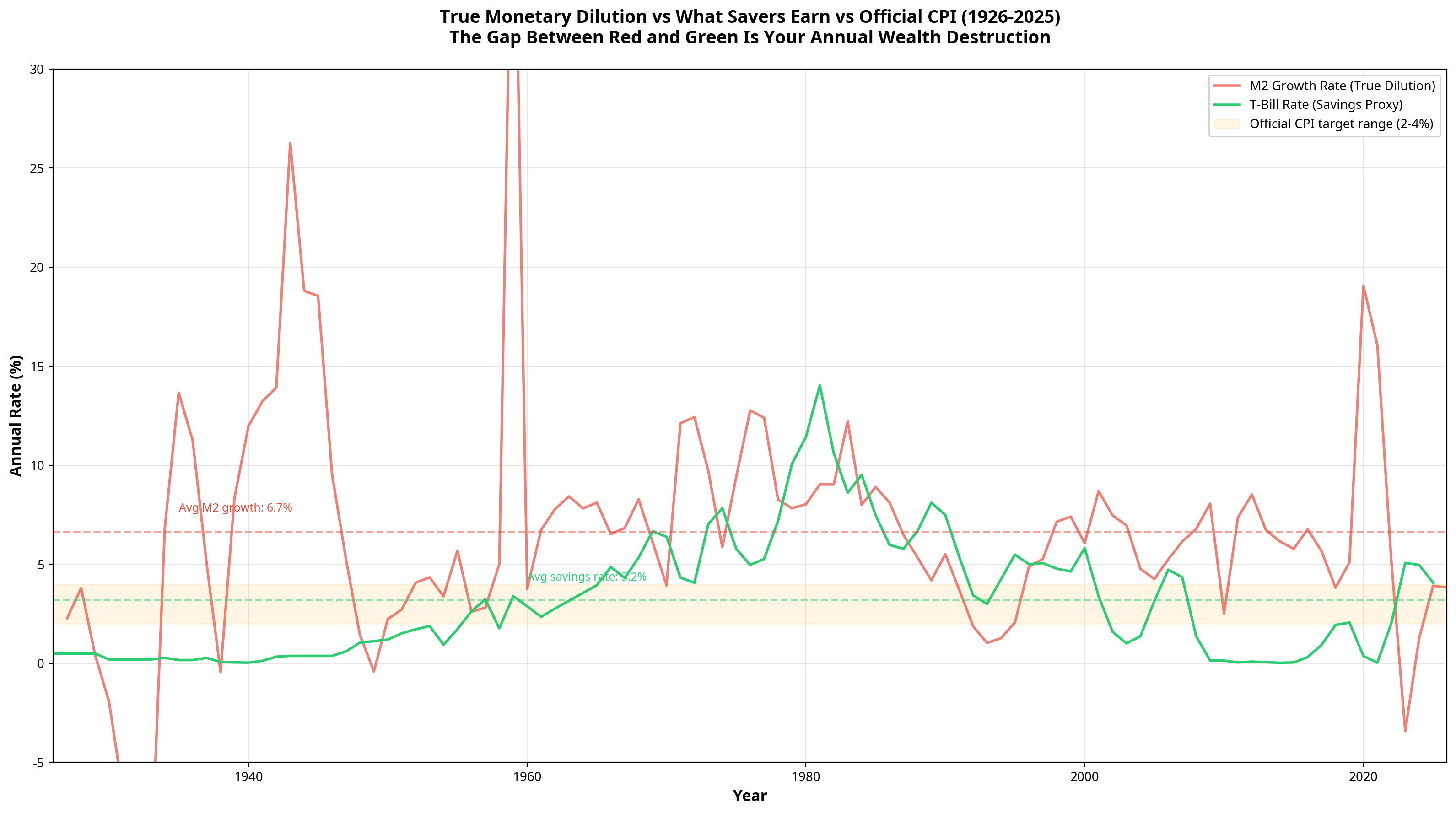
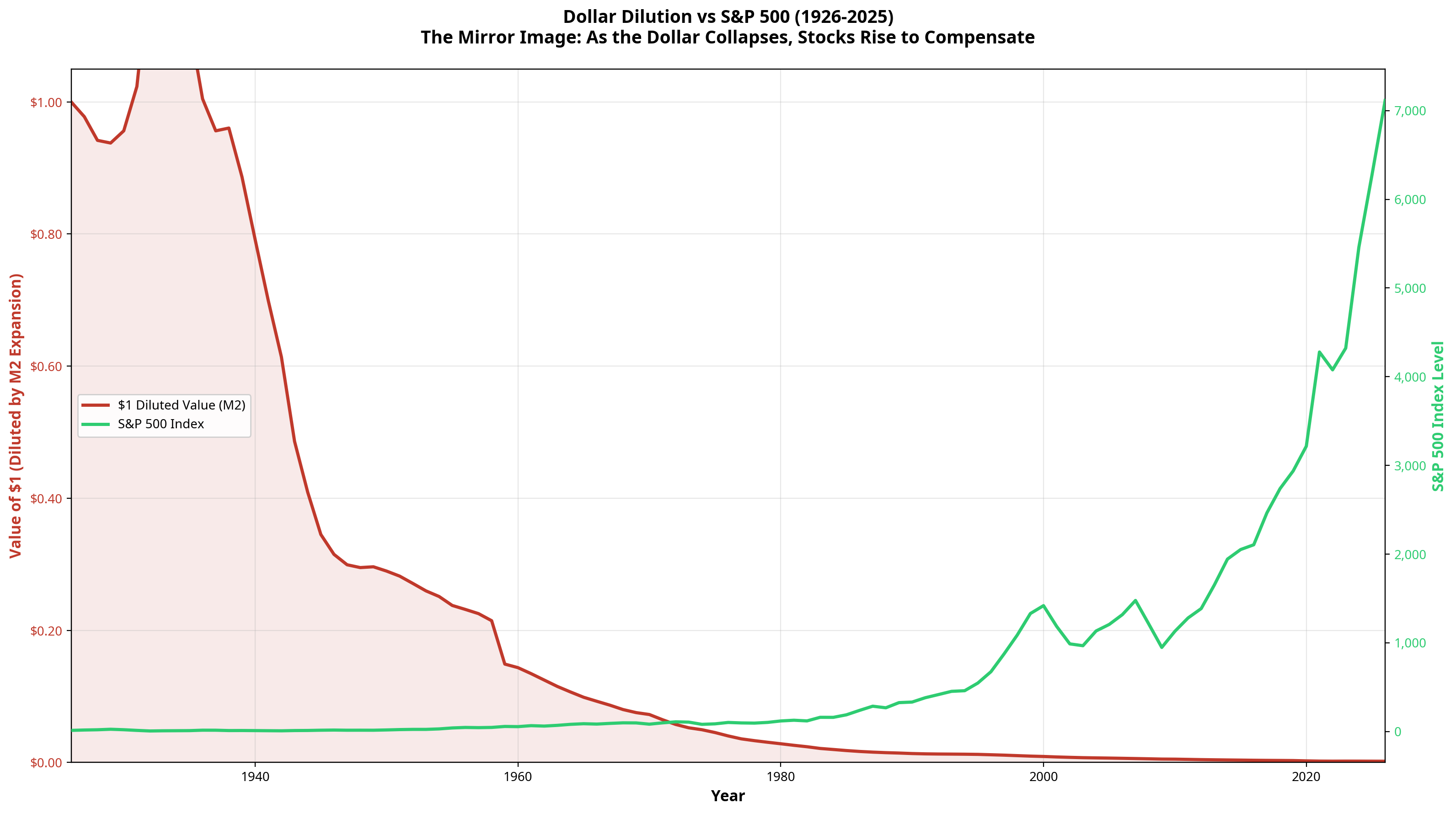
We used the 3-Month Treasury Bill rate as a proxy for the best safe savings yield available [4], and over the last 100 years it averaged 3.17%.
The average annual M2 growth rate, which is the true rate of monetary dilution, was 6.66% over the same period.
Put those two numbers together and, on average, a saver has lost 3.48% of their wealth every single year for a century just by holding cash in a bank. In the chart above, the gap between the red line (money printing) and the green line (interest earned) is that loss, and we think of it as pure wealth destruction.
The Death of the Saver
To see what that does over a lifetime and beyond, we tracked a hypothetical $1 deposited in a savings account in 1926, with the interest reinvested every year until 2025.
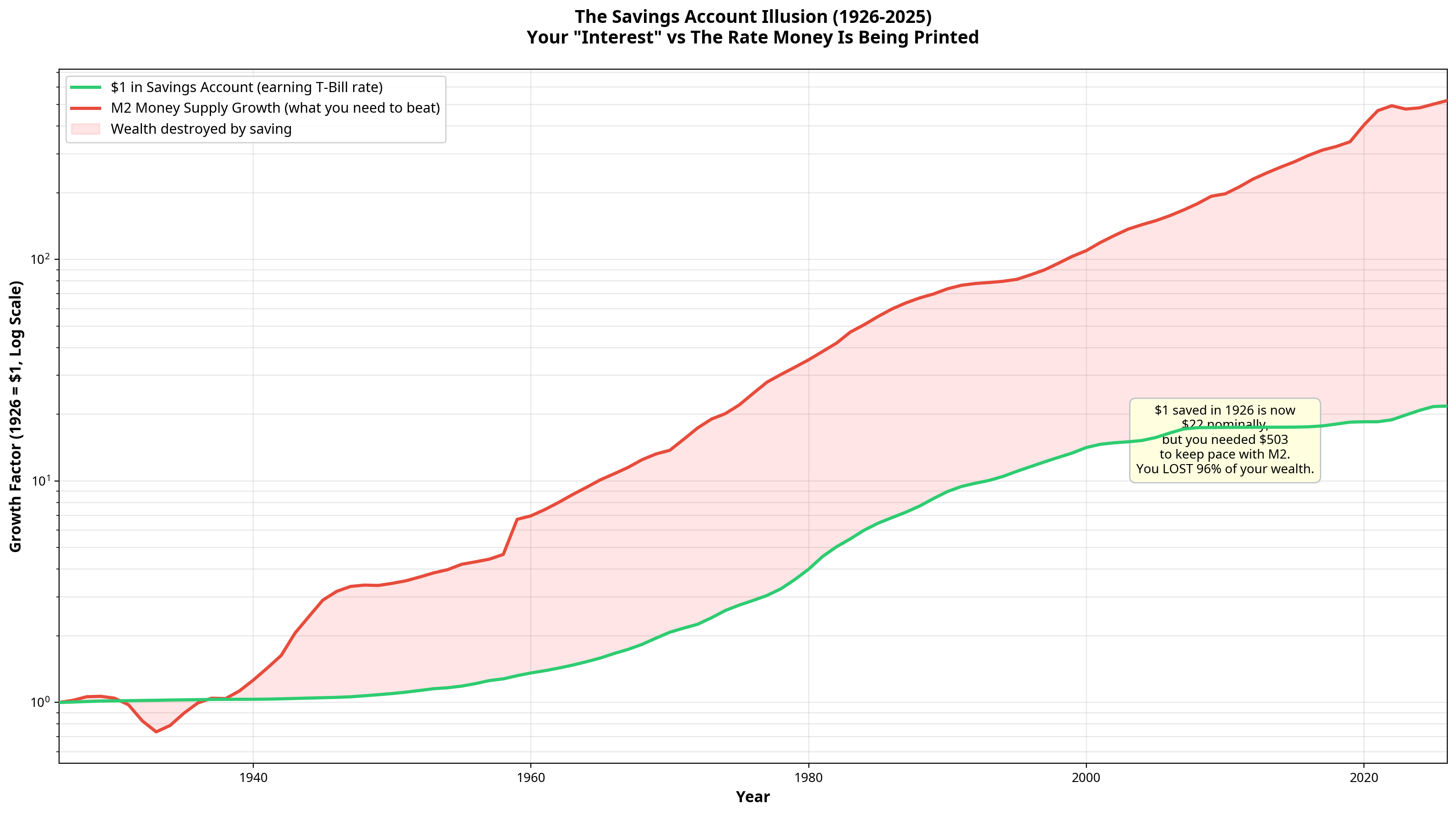
Nominally the saver feels as if they have won, because their $1 has grown to $21.68.
To merely keep their 1926 purchasing power against the expanded money supply, though, that account needed to grow to $503.
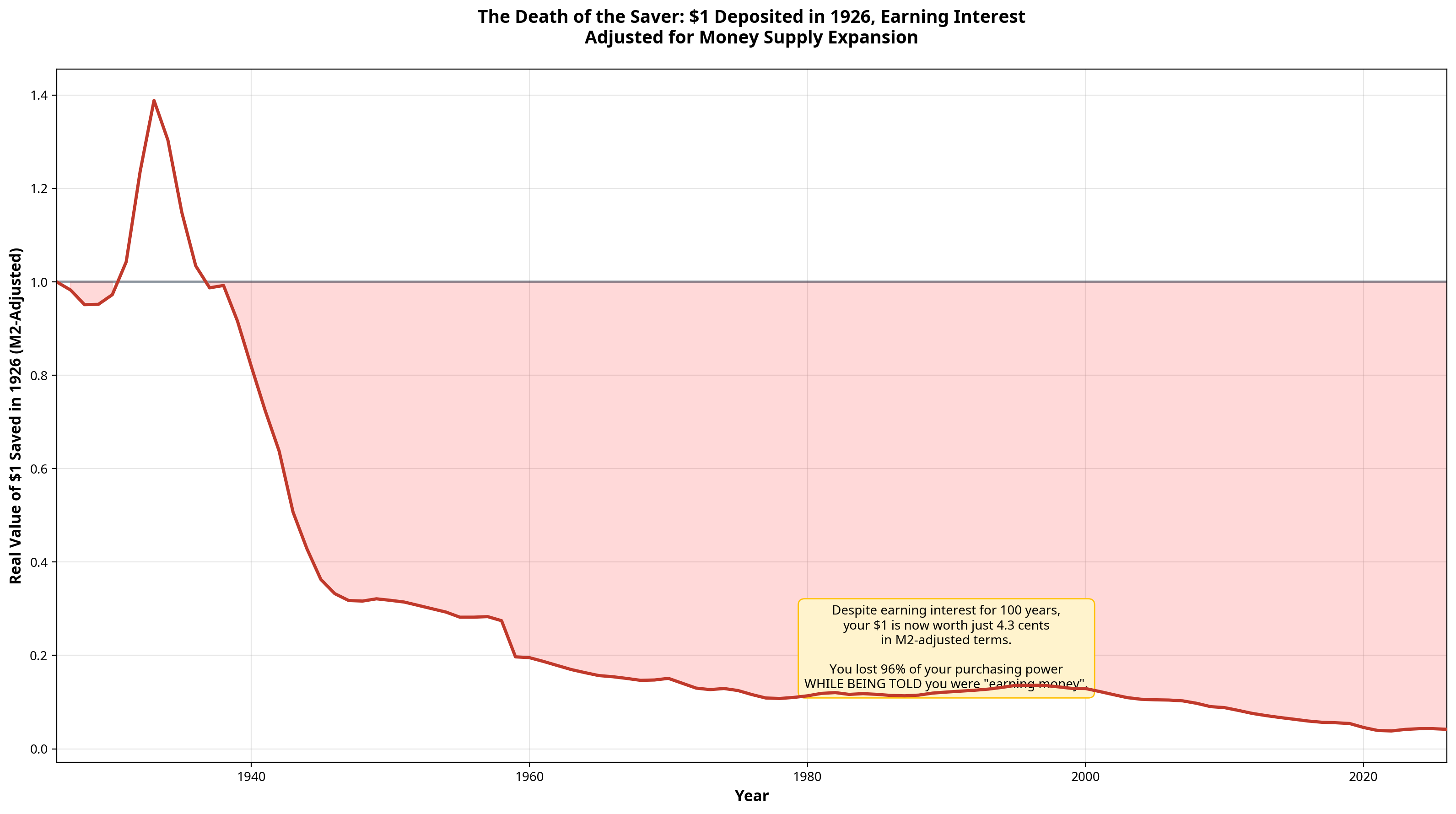
Once we adjusted for M2 expansion, that $1 was worth just 4.3 cents, so despite “earning interest” for 100 years the saver has lost nearly 96% of their wealth.
Conclusion: The Full Picture
When we put all the strategies side by side, the effect of the fiat monetary system on each of them was hard to miss.
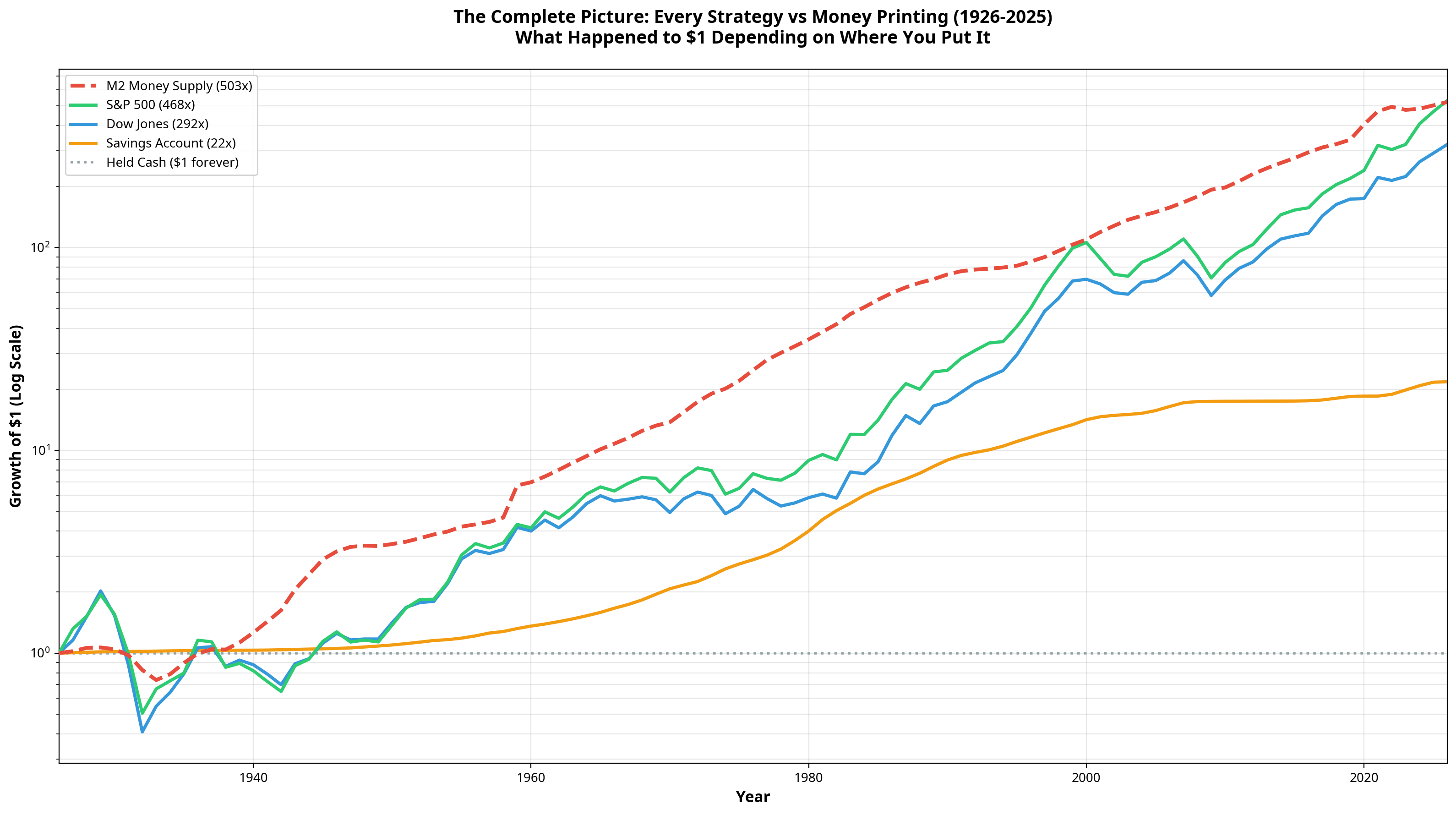
| Strategy | Nominal Gain | M2-Adjusted | Verdict |
|---|---|---|---|
| M2 Money Supply | 503x | 1.000 | BASELINE |
| S&P 500 | 468x | 0.932 | LOST |
| Dow Jones | 292x | 0.581 | LOST |
| Savings Account | 22x | 0.043 | LOST MASSIVELY |
| Held Cash Under Mattress | 1x | 0.002 | LOST EVERYTHING |
None of the traditional financial strategies we tested, not even the S&P 500, managed to outrun the printing press over a 100-year timeframe.
From what we saw, the stock market works less as a wealth-creation machine than as a way of preserving wealth, one that tries to keep pace with currency devaluation and falls slightly short. The market crashes looked to us largely like symptoms of central bank tightening, and cash savings lost almost all of their purchasing power over the period.
In the next phase of this analysis we zoom in on the last 20 to 60 years to look at newer assets, including the Nasdaq, the MSCI All World index and Bitcoin, because we wanted to see whether the digital age has finally produced an asset capable of outrunning the expansion of the money supply.
References
- [1] Federal Reserve Economic Data (FRED). “M2 Money Supply (M2SL).” Federal Reserve Bank of St. Louis.
- [2] Macrotrends. “S&P 500 - 100 Year Historical Chart.”
- [3] Macrotrends. “Dow Jones - 100 Year Historical Chart.”
- [4] Federal Reserve Economic Data (FRED). “3-Month Treasury Bill Secondary Market Rate (TB3MS).” Federal Reserve Bank of St. Louis.


